
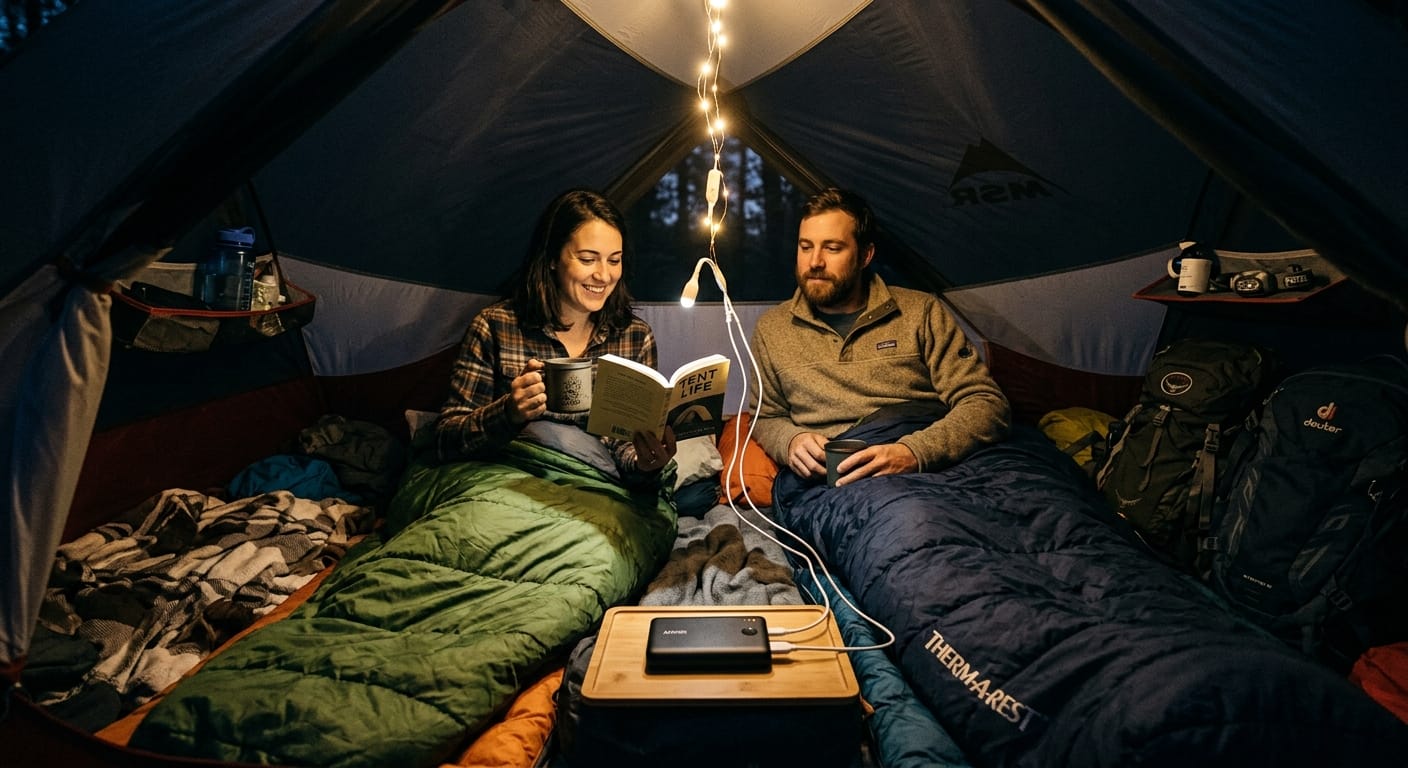
When severe weather knocks out grid power or you are packing gear for a multi-day backcountry trek, having dependable off-grid energy is essential. Modern mobile devices, navigation tools, headlamps, and medical hardware all rely on USB power. Choosing the best power banks for camping and emergency preparedness requires looking past flashy marketing numbers and evaluating real-world usable energy, charging efficiency, port configurations, and rugged durability.
In our field testing at Off Grid Watts, we have tested dozens of battery packs across rainstorms, freezing temperatures, and extended off-grid expeditions. Below is our definitive 2026 field guide to selecting the right portable power bank for camping, storm readiness, and mobile backup power.
The Backcountry Power Rule: Usable Energy vs. Marketing Specs
- The Milliamp-Hour (mAh) vs. Watt-Hour (Wh) Formula: Battery capacities are usually advertised in milliamp-hours (mAh), but mAh ratings only tell half the story because they reflect the raw lithium cell voltage (3.7V), not the output voltage (5V, 9V, 12V, or 20V). To calculate actual stored energy in watt-hours (Wh), use the formula:
Watt-Hours (Wh) = (Capacity (mAh) × 3.7V) / 1000- Example: A 20,000mAh bank provides 74Wh of nominal energy (20,000 × 3.7 / 1000).
- The 100Wh Airline Limit: The FAA and TSA enforce a strict 100Wh limit on lithium-ion batteries in carry-on baggage without prior airline approval. That caps standard travel power banks at approximately 27,000mAh (99.9Wh).
- Real-World Efficiency & Conversion Loss: Voltage stepping (converting 3.7V cell voltage up to 5V–20V USB outputs) and heat dissipation result in energy conversion loss. High-quality USB-C Power Delivery (PD) circuits generally deliver 75% to 85% real-world efficiency. A 74Wh pack will deliver roughly 56Wh to 63Wh of actual usable power to your connected devices.
The Solar Power Bank Myth: What You Must Know First
One of the most frequent questions we receive is how to use solar power bank models effectively in the backcountry. Retailers frequently promote power banks featuring a built-in miniature solar panel glued to the casing as “infinite self-charging solar generators.”
The Bench Test Reality:
A tiny built-in 1.5W photovoltaic panel produces roughly 200mA to 300mA under optimal, direct midday sunlight. At that trickle rate, fully recharging a depleted 20,000mAh battery pack purely from the integrated panel requires 50 to 80+ hours of unobstructed direct sunlight. Leaving a lithium battery pack baking on a hot rock in 95°F heat will severely degrade the internal battery chemistry long before it reaches a full charge.
The Best Practice:
- Treat built-in solar panels strictly as an emergency trickle-charge lifeline to power a single 911 call or revive a dead GPS unit in a survival scenario.
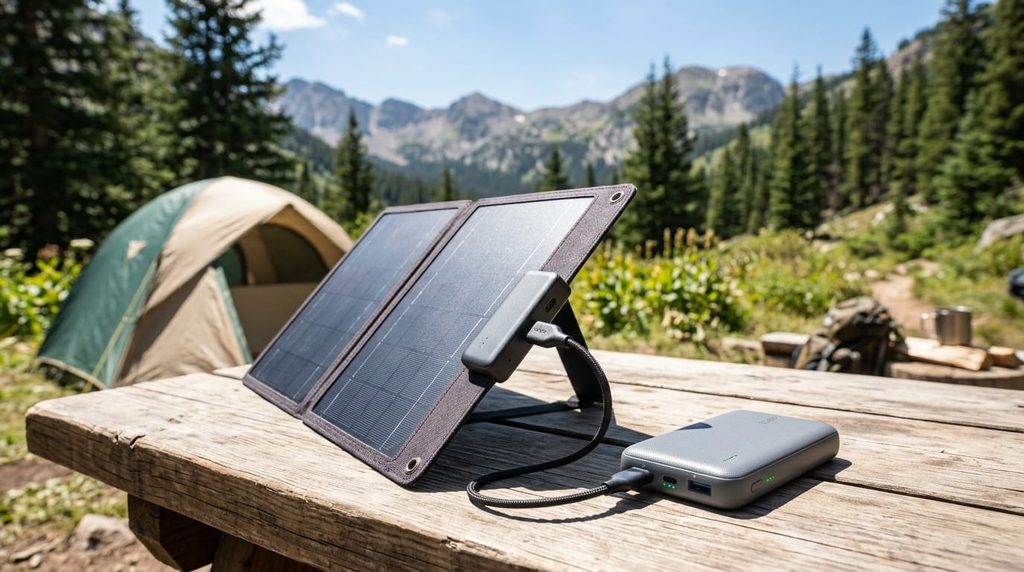
- For reliable, true off-grid solar replenishment, learn how to charge power bank gear using an external 15W to 30W folding solar panel array connected via high-efficiency USB-C PD.
Top 5 Camping & Storm Power Banks (Ranked & Reviewed)
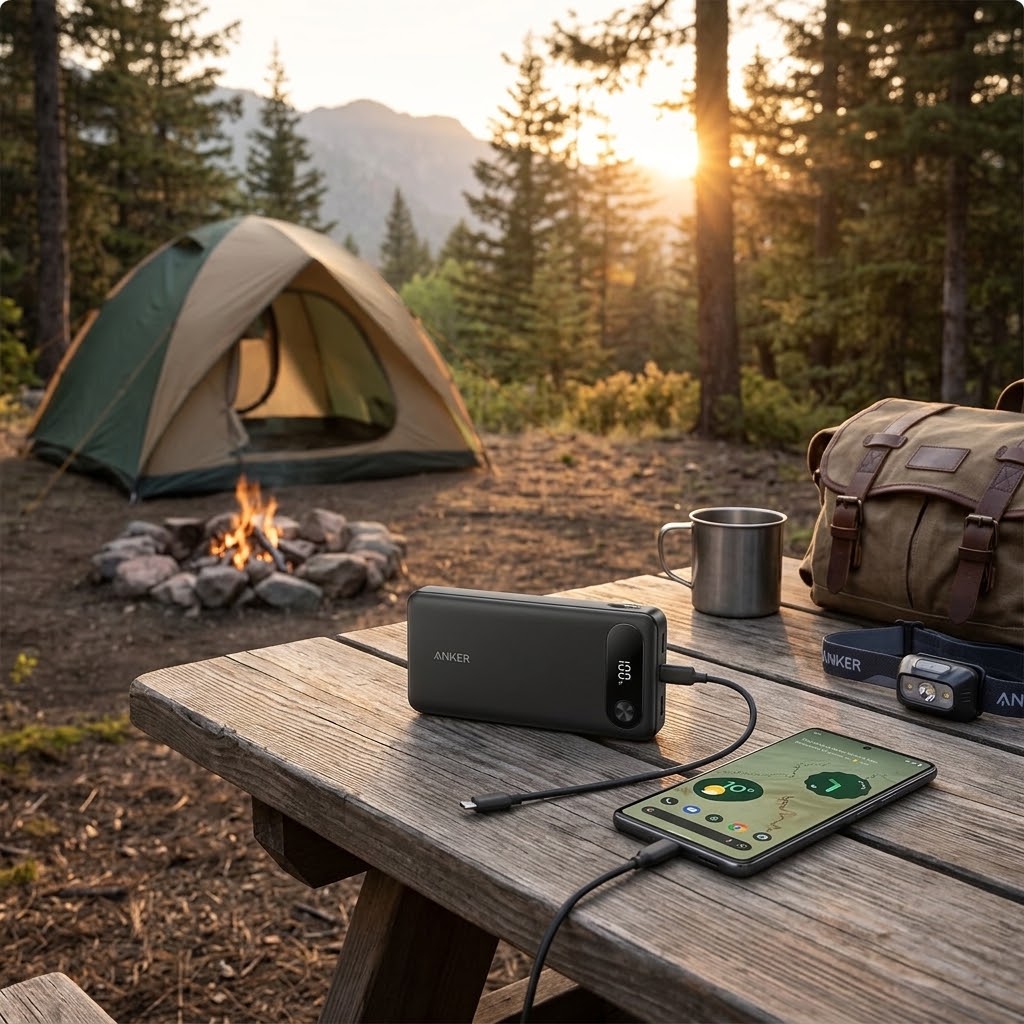
1. Best Overall Rugged Workhorse: Anker Power Bank 20000mAh 65W
For most campers, overlanders, and emergency preppers, a 20,000mAh (74Wh) bank with a 65W bidirectional USB-C PD port represents the ideal sweet spot between weight, capacity, and power output.
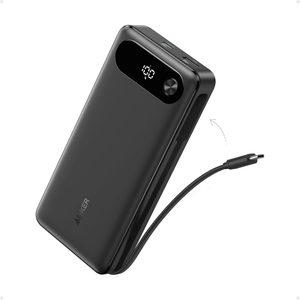
- Performance: Delivers 4 to 5 full charges for modern smartphones, 1.5 full charges for a tablet, or a full recharge for a 13-inch USB-C laptop.
- Versatility: The 65W output provides enough voltage overhead to power 12V/20V DC step-up trigger cables for running mini Wi-Fi routers, radio chargers, or camera battery sleds directly from the bank.
- Recharge Speed: Because the input supports 65W PD, the bank can be recharged from empty to 100% in under 2 hours when paired with a high-wattage GaN wall charger or portable generator outlet.
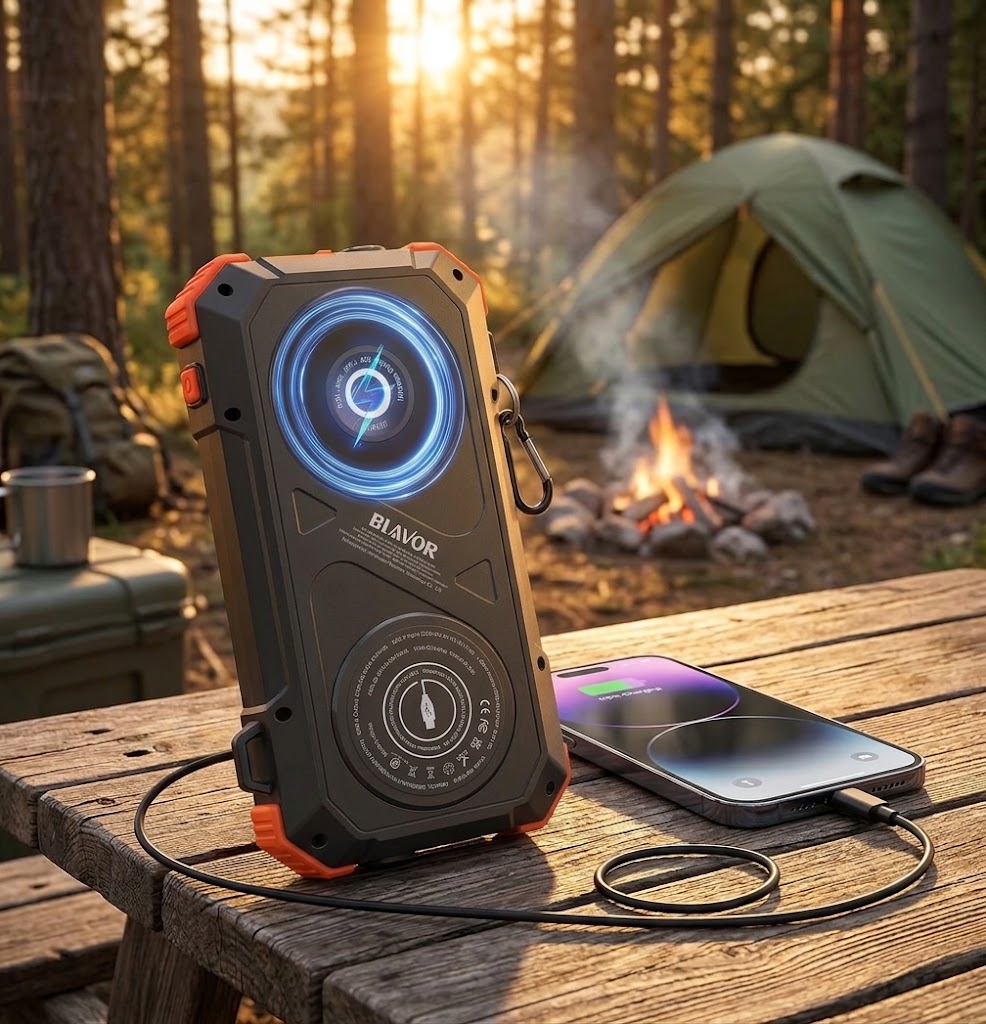
2. Best Integrated Solar & Utility Camp Bank: Blavor Rugged IP67 Bank with LED Floodlight
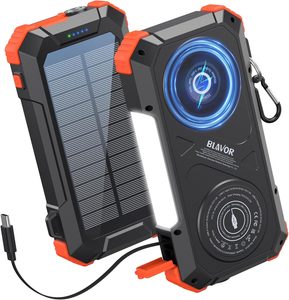
If you need an all-in-one basecamp utility unit that can withstand torrential rain, mud, and accidental drops, a Blavor IP67-rated 20,000mAh rugged utility bank is a dependable choice.
- Camp Lighting: Features a wide-angle, multi-mode LED panel providing up to 500 lumens of clean flood lighting, eliminating the need for a separate battery lantern.
- Build Quality: Enclosed in reinforced rubberized drop bumpers with sealed silicone port gaskets, preventing water ingress during severe weather.
- Emergency Solar Utility: Includes a small top-mounted solar cell for passive trickle charging and a reinforced carabiner clip for securing to the outside of a rucksack.
- Retractable USB-C Cable
3. Best Ultralight Pocket Bank for Day Hikes: Anker 10000mAh Slim Portable Charger
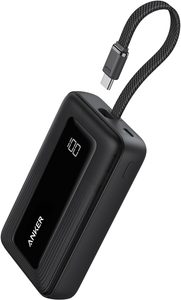
When every ounce counts on technical day hikes, fast-packing trips, or minimal bug-out bags, a slim 10,000mAh (37Wh) lithium-polymer battery pack offers essential power without added bulk.
- Form Factor: Weighs under 7.5 ounces (212g) and features a profile thinner than most smartphones.
- Output: Features 20W to 30W USB-C PD, enough to fast-charge a phone from 0% to 50% in approximately 30 minutes.
- Camp Lighting Efficiency: Highly effective for powering an ultra-low-draw camping usb light (such as a 5V 1W–3W USB bulb) inside a tent for multiple consecutive nights.
4. Best Heavy-Duty High-Output Bank: Anker Prime 27,600mAh with 100W–140W USB-C PD
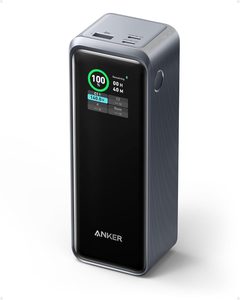
When operating high-drain electronics, fieldwork laptops, or medical equipment off-grid, maxing out the legal airline limit with a 27,600mAh (99.9Wh) heavy-duty pack provides commercial-grade output in a compact footprint.
- Medical & High-Draw Utility: Capable of running travel CPAP machines (such as the AirMini via a dedicated 24V USB-C trigger cord) for a full night when humidity and heated tubing settings are disabled.
- Multi-Device Output: Simultaneously powers a 65W–100W laptop and an iPhone without throttling either port.
- Digital Telemetry: High-end models include real-time smart digital displays showing active wattage in/out, remaining runtime hours, and cell health.
5. Best Value Multi-Device Pack: Miady 2-Pack 10000mAh Portable Charger Banks
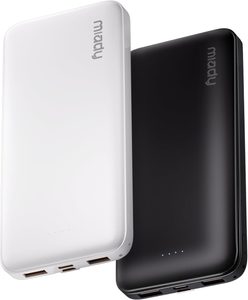
During extended power outages or group camp-outs, distributing power across multiple locations is often safer and more practical than consolidating all stored energy into a single large pack.
- Basecamp Redundancy: A dual-pack allows you to keep one bank charging at the vehicle or solar array while the second powers lighting or communications at camp.
- Emergency Preparedness: Provides dedicated backup packs for individual family emergency packs, glove boxes, and home blackout kits.
- Reliability: Built with standard 5V/3A and 15W–20W outputs, offering reliable everyday performance at an affordable price per watt-hour.

Power Bank Runtime Matrix: What Can You Actually Run?
| Nominal Bank Capacity | Nominal Energy (Wh) | Usable Energy (~80% Efficiency) | Smartphone Recharges (Avg. 12Wh Battery) | 5V USB Hanging LED Bulb Runtime (3W) | 12V DC Wi-Fi Router Runtime (8W via Trigger) |
|---|---|---|---|---|---|
| 10,000 mAh | 37.0 Wh | ~29.6 Wh | 2.4 Full Charges | ~9.8 Hours | ~3.7 Hours |
| 20,000 mAh | 74.0 Wh | ~59.2 Wh | 4.9 Full Charges | ~19.7 Hours | ~7.4 Hours |
| 27,000 mAh | 99.9 Wh | ~79.9 Wh | 6.6 Full Charges | ~26.6 Hours | ~10.0 Hours |
3 Pro Tips to Maximize Power Bank Lifespan Outdoors
1. Protect Lithium Cells from Extreme Temperatures
Lithium-ion and lithium-polymer cells operate best between 50°F and 85°F (10°C to 29°C).
- Cold Weather Degradation: When temperatures drop below freezing (32°F / 0°C), internal resistance increases dramatically, causing voltage drops and capacity reduction. Never charge a frozen power bank, as doing so can cause permanent lithium plating and short circuits. Store your battery pack inside your sleeping bag or an insulated jacket pocket during cold nights.
- Heat Management: Avoid leaving battery packs inside hot vehicles or direct summer sunlight. Sustained heat accelerates thermal degradation and triggers internal safety shutdown circuits.
2. Streamline Your Recharge Sequencing
Standard 5W phone charging blocks can take 12 to 20 hours to refill a large 20,000mAh bank. To keep field recharge times fast:
- Use a GaN (Gallium Nitride) wall charger rated for at least 45W–65W PD when preparing before a storm or charging from an AC inverter.
- When charging in the field, pair your power bank with an external 21W to 28W folding solar panel array equipped with a regulated USB-C output to recharge efficiently during daylight hours.
3. Account for Pass-Through Charging & Thermal Loads
Pass-through charging allows a power bank to charge connected devices while simultaneously receiving power from an external source (such as a wall plug or solar panel).
- While convenient for daisy-chaining gear, pass-through charging generates substantial heat because the power management IC handles incoming and outgoing power at the same time.
- Ensure your bank sits in a shaded, ventilated area when using pass-through charging, and disconnect downstream devices if the casing feels excessively hot.
Internal Interlinking & Related Guides
To continue building out your off-grid power ecosystem, explore our related technical field guides:
- 5 Emergency Blackout Accessories Under $35 That Save Battery Life — Learn how ultra-efficient camping usb light fixtures and 12V DC step-up trigger cords keep essential systems running while minimizing battery drain.
- How to Run a CPAP Machine Off-Grid — Discover step-by-step instructions for powering medical devices using high-capacity 65W+ USB-C PD power banks and DC adapters.
- How to Charge a Power Bank with a Solar Panel — Our complete bench-tested guide on sizing folding solar panel arrays, avoiding USB throttling, and safely charging lithium power banks outdoors.
Leave a Reply