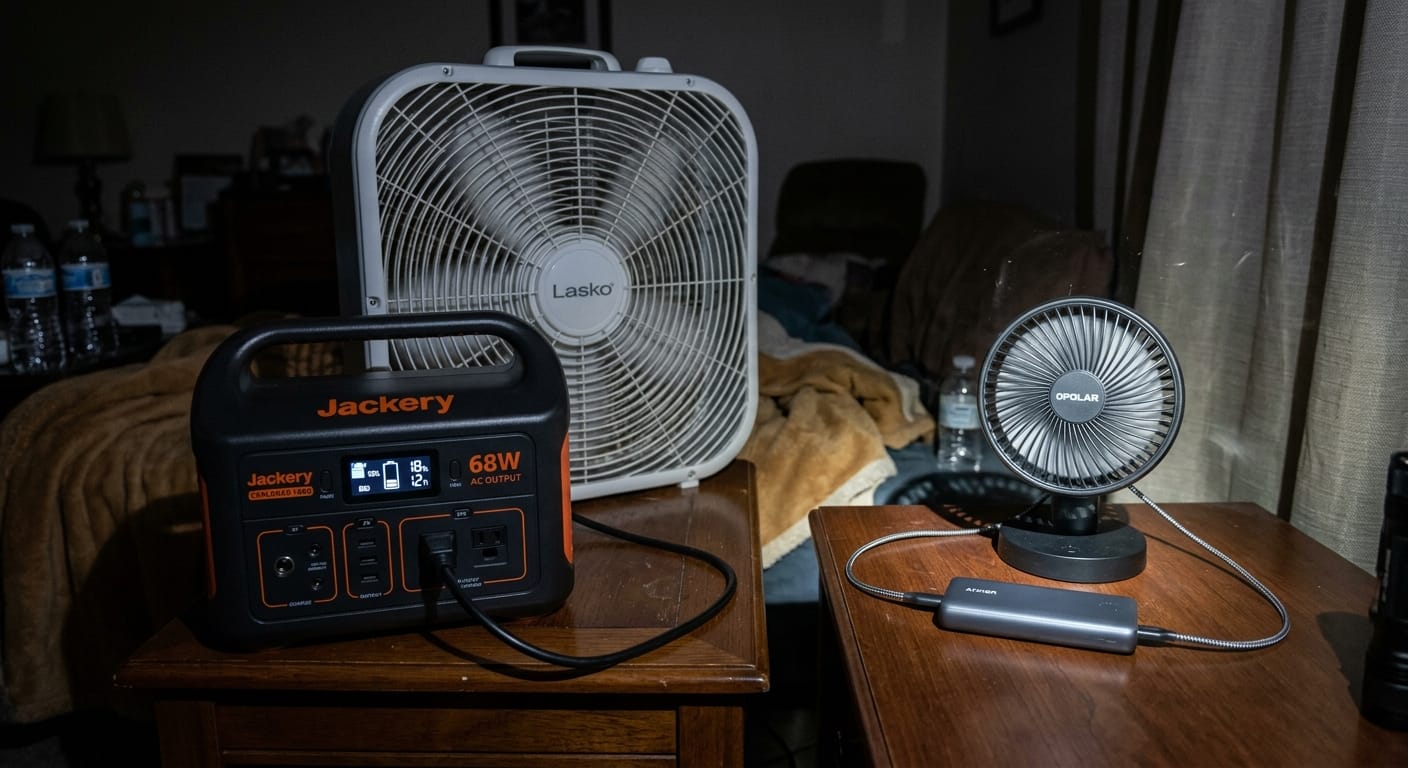
When summer storms or grid failures strike, mastering how to stay cool during power outage conditions comes down to a single engineering principle: watt management. Most homeowners make the immediate, costly mistake of plugging standard 120V household appliances into a portable power station. Within hours, the backup battery sits at zero percent, leaving the house hotter than before.
Surviving a blackout in high ambient heat does not require firing up a noisy gas generator or exhausting a multi-thousand-dollar battery setup. By cutting out AC inversion entirely and switching to direct 5-volt DC hardware, you can achieve continuous, active cooling across multiple nights for less than $30 in gear.
1. The Inverter Trap: Why 120V AC Drains Your Battery Overnight
Plugging a standard 20-inch box fan or oscillating pedestal fan into your power station’s AC wall-style outlet seems logical, but it triggers what off-grid technicians call the “inverter penalty.”
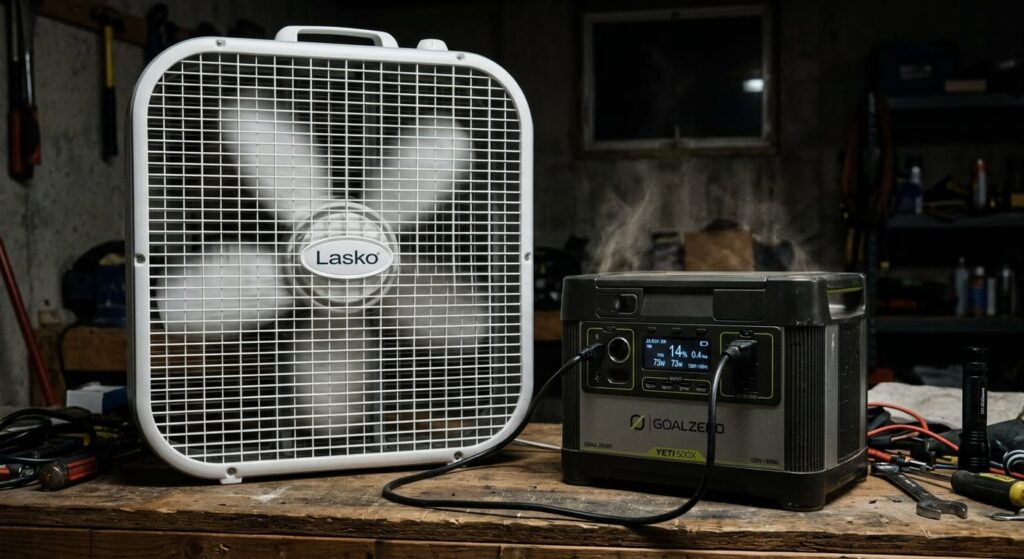
A standard household box fan draws roughly 45W to 60W on low to medium speed. However, the fan motor is not the only load draining your pack. To deliver alternating current, your power station must activate its internal DC-to-AC pure sine wave inverter. Inverter idle overhead—the baseline power required just to keep internal transformer circuits energized—burns an additional 15W to 30W continuously, regardless of the connected load.
Do the math on a typical 500Wh (watt-hour) lithium power station:
- Fan motor draw: 50W
- Inverter idle overhead: 25W
- Total continuous system load: 75W
- Usable capacity (accounting for ~85% conversion efficiency): ~425Wh
- Total runtime: 425Wh / 75W = 5.6 hours
Your 500Wh backup system is completely exhausted before sunrise. If you run a smaller 250Wh entry-level power station, the inverter trips out in under three hours. Converting battery DC power to AC just to run a simple electric motor is an unforced tactical error in emergency power planning. Very inefficient and not how to stay cool during a power outage.
2. The 5V DC Solution: Native Low-Voltage Efficiency
The most efficient strategy for how to stay cool during power outage emergencies is bypassing the AC inverter completely and using native DC USB ports.
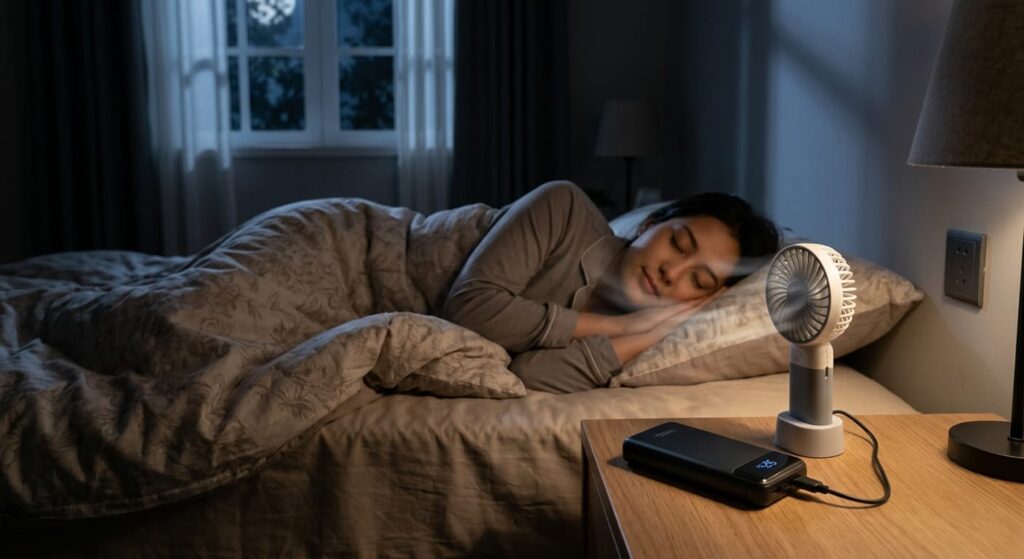
Brushless DC (BLDC) motors powered by standard 5V USB connections deliver exceptional aerodynamic efficiency per watt. A well-engineered 5V personal fan pulls only 3W to 5W on medium-to-high settings. Because the fan runs directly off native USB-A or USB-C ports, inverter idle draw is zero.
Consider the runtime achievable with an everyday $15 to $20 pocket-sized 10,000mAh power bank (rated at 3.7V / 37Wh nominal capacity):
- Average fan power draw: 4W
- Effective usable capacity after DC step-down (~80% conversion efficiency): ~30Wh
- Continuous runtime: 30Wh / 4W = 7.5 to 10 hours on high, and 12 to 15+ hours on low/medium.
A power bank no larger than a smartphone supplies an entire night of direct, convective cooling over your bed without touching your primary home battery reserves.
3. Recommended Under-$30 Gear for How to Stay Cool During a Power Outage- The Breakdown
Keep these three low-draw 5V DC tools staged in your blackout kit:
Product 1: 5V USB Hanging Tent/Ceiling Fan with Remote (~$15–$20)
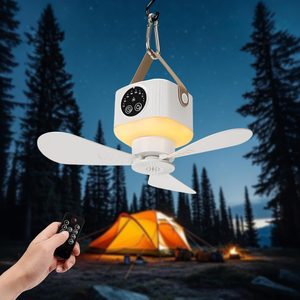
Equipped with a built-in hanging hook and detachable blades, this unit suspends directly from a ceiling hook, curtain rod, or bed frame. Drawing only 3W–4.5W, it generates downward laminar airflow that blankets an entire sleeping area. The included remote control allows speed adjustments and sleep-timer configuration without getting out of bed.
Product 2: Rechargeable Clip-On Personal Misting Fan (~$18–$24)
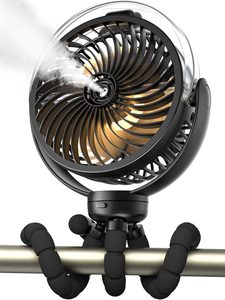
Evaporative cooling drops skin surface temperatures significantly faster than dry airflow alone. This compact unit combines a brushless motor with an integrated ultrasonic misting nozzle and an internal 6,000mAh rechargeable battery. Clip it directly to a headboard or cot rail for targeted convective relief.
Product 3: Low-Wattage Direct USB Bedside Air Circulator (~$12–$16)
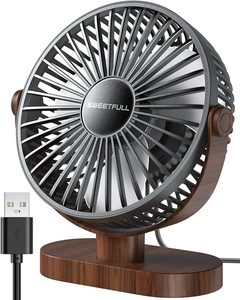
For directional air movement, a dedicated 5-inch USB desk circulator provides focused airflow while pulling a modest 2.5W to 3.5W. Positioned 18 to 24 inches from your torso, it accelerates sweat evaporation continuously without vibration or motor noise.
| Cooling Setup | Power Source | Operating Draw | Inverter Idle Draw | Total System Draw | Runtime: 10k mAh Bank | Runtime: 500Wh Station |
|---|---|---|---|---|---|---|
| Standard 20″ Box Fan (120V AC) | AC Inverter Port | 50W | 20W | 70W | Incompatible | ~6.0 Hours |
| 5V USB Hanging Ceiling Fan (DC) | Native USB Port | 4W | 0W | 4W | 12-15 Hours | 105+ Hours |
| Rechargeable Clip Misting Fan (DC) | Native USB Port | 3.5W | 0W | 3.5W | 10-12 Hours | 120+ Hours |
| USB Bedside Air Circulator (DC) | Native USB Port | 3W | 0W | 3W | 12-16 Hours | 140+ Hours |
5. Quick Tactical Staging Checklist
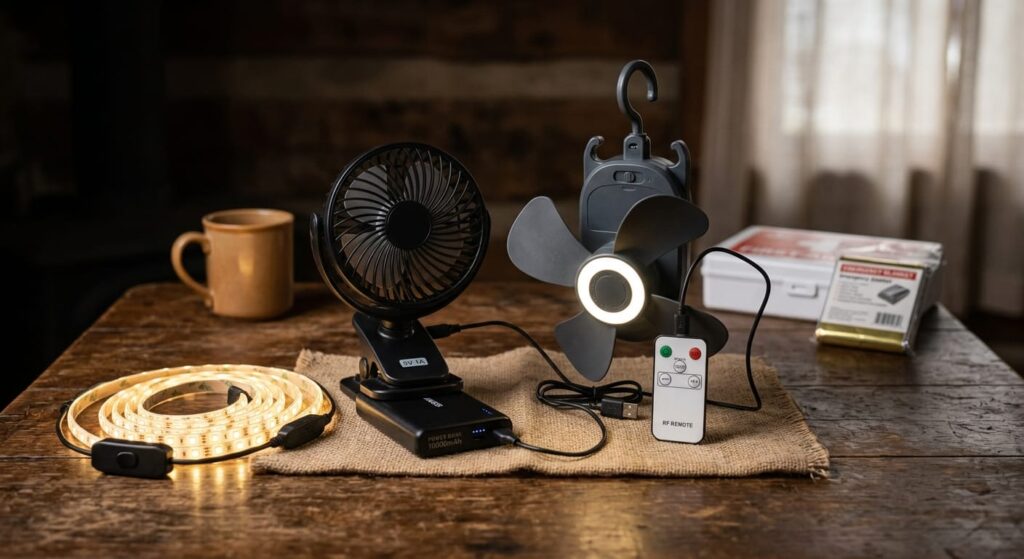
Hardware alone will not maintain personal comfort if thermal transfer inside the living space is neglected. Deploy these three rules as soon as the grid drops:
- Thermal Blocking: Seal south- and west-facing windows immediately using reflective foil barriers, blackout curtains, or rigid insulation boards to reject radiant solar heat before it loads the interior drywall.
- Low-Elevation Cross-Breeze: Sleep as close to the floor as possible to exploit natural thermal stratification, and position DC circulators to sweep cool air directly across your torso rather than blowing warm ambient air trapped near the ceiling.
- Evaporative Skin Loading: Place a damp cloth or microfiber towel over your neck and arms directly in the fan’s airflow; the continuous air velocity triggers phase-change evaporation that actively strips heat from arterial blood flow.
Surviving high-heat outages is a challenge of thermal efficiency, not raw electrical storage. Stop paying the AC inverter tax—switch your cooling to native 5V DC and stretch hours of emergency runtime into days.
Leave a Reply