The 30-Second Bottom Line
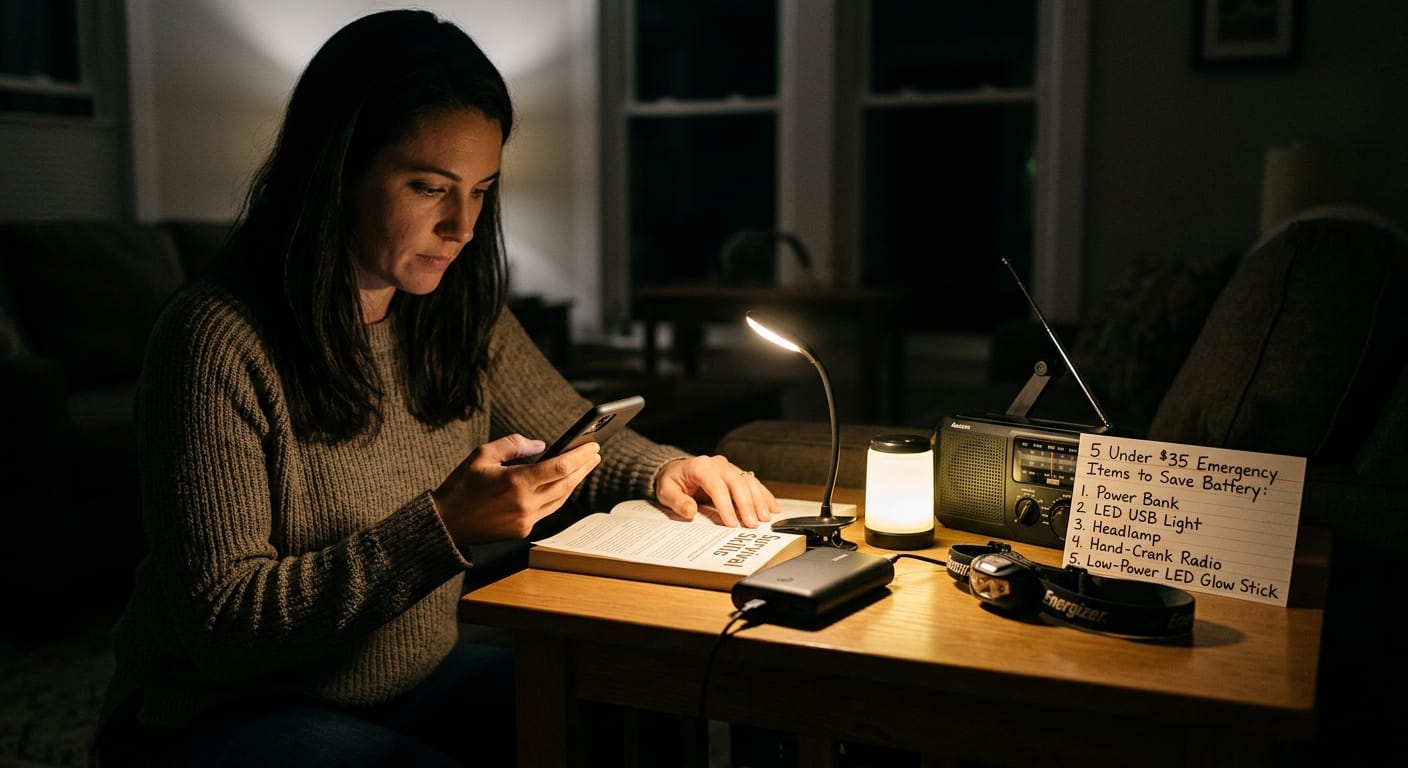
The single biggest mistake we see during storm outages is running massive 120V AC inverters for tiny 5W–15W loads. Inverter conversion overhead and idle standby draw waste 20% to 30% of your power station’s battery capacity as pure phantom heat before powering a single device. Investing in sub-$35 direct 5V and 12V DC emergency blackout accessories lets you bypass the inverter completely. In our bench tests, direct DC power keeps critical home Wi-Fi, ambient room lighting, and essential electronics running 3x to 5x longer on the exact same battery reserve.
1. USB-A/C to 12V DC Router Step-Up Cable ($8 – $12)
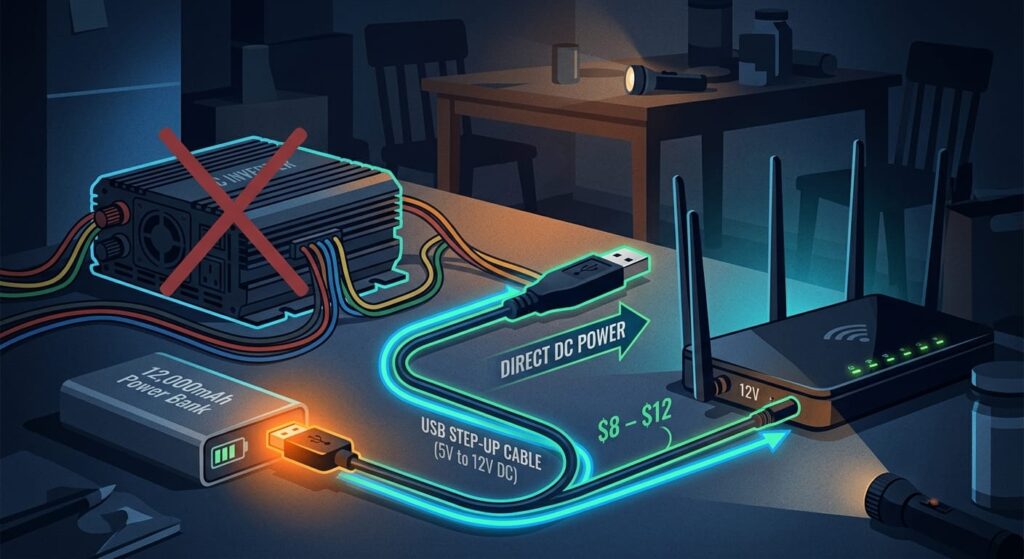
When severe weather knocks out grid power, neighborhood cell towers often choke within hours due to surging network traffic. Your home broadband line or fiber-optic terminal frequently remains fully functional, but keeping your home Wi-Fi online usually drains backup power stations far too quickly if you rely on standard wall plugs.
👉 Check Price on Amazon – USB to 12V DC Step-Up Cable
Why It’s Essential
Nearly all residential Wi-Fi routers, cable modems, and fiber Optical Network Terminals (ONTs) operate internally on 12V DC via a standard 5.5mm barrel jack. Powering them with their standard AC wall transformer forces a double-conversion penalty: your power station inverts DC battery power up to 120V AC, and the wall adapter immediately converts it back down to 12V DC. This inefficiency burns significant battery life in idle overhead alone.
The Battery Savings
- AC Inverter Draw: Running a router through a 120V wall plug consumes 25W to 35W total (including 15W–20W inverter idle loss). On a standard 500Wh power station, your runtime maxes out at roughly 14 to 18 hours.
- Direct 12V DC Step-Up Draw: A dedicated USB step-up cable draws only 6W to 10W total. That same 500Wh power station will now run your home network for 50+ hours continuously.
- Pocket Bank Deployment: A compact 20,000mAh (74Wh) pocket power bank keeps your router and ONT powered for 7 to 10 hours, preserving your main power station for heavy refrigeration cycles.
Key Pros & Field Takeaways
- Universal 5.5mm x 2.1mm / 2.5mm Plugs: Compatible with 95% of Netgear, ASUS, TP-Link, and ISP-issued gateways.
- Integrated Step-Up Circuitry: Converts standard 5V USB-A or USB-C power into a stable, regulated 12V DC output (up to 1A / 12W).
- Completely Silent Operation: Eliminates continuous inverter cooling fan noise in living spaces and bedrooms.
2. 5V USB Warm-White LED Hanging Bulbs ($12 – $16 for a 2-Pack)
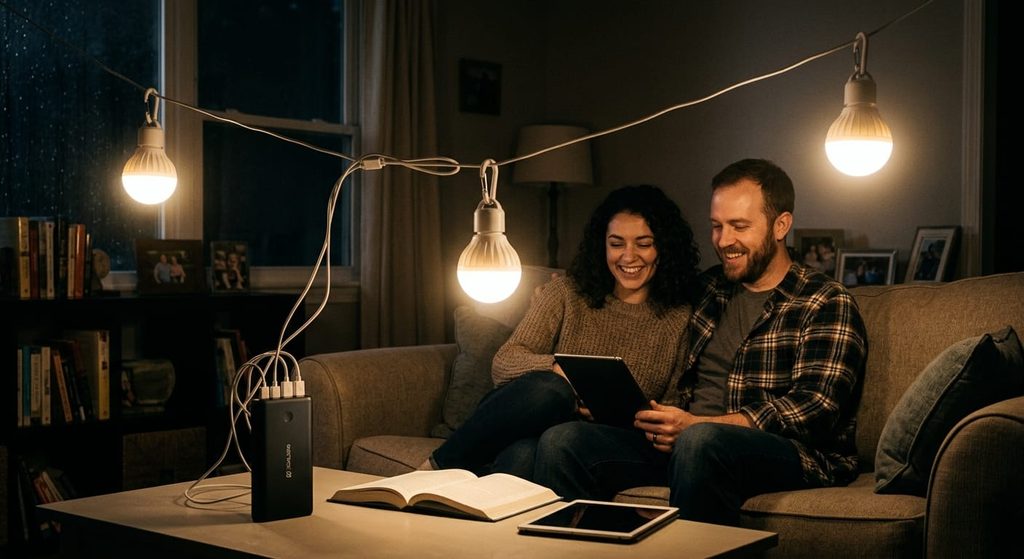
Flashlights produce narrow, blinding beams, while disposable battery lanterns burn through costly alkaline cells within days. Standard floor and desk lamps require turning on your battery’s AC inverter, which quickly burns power on empty overhead.
👉 Check Price on Amazon – Dimmable USB LED Hanging Bulbs 2-Pack
Why It’s Essential
These hanging 5V USB LED bulbs are designed to plug directly into any USB port on your power station, laptop, or compact power bank. Featuring built-in toggle switches and hanging carabiners/hooks, they can be suspended from ceiling fans, door frames, or shelving to cast wide, 360-degree ambient light across an entire kitchen or living room.
The Battery Savings
- AC Lamp via Inverter: Running a standard 9W household LED bulb through an inverter pulls 24W to 30W total, depleting a 300Wh battery in 10 to 12 hours.
- Direct 5V USB Bulbs: Each USB hanging bulb pulls just 2W to 5W while outputting 300 to 450 lumens of glare-free, warm-white light.
- Pocket Power Bank Pairing: A basic 10,000mAh (37Wh) phone power bank can power one bulb for 12+ hours straight, giving you days of room lighting without touching your main generator or solar reserves.
Key Pros & Field Takeaways
- Minimal Power Draw: Operates on 2W to 5W per bulb with multiple brightness settings for nighttime comfort.
- Long Integrated Leads: Includes 6.5-foot to 8-foot USB cables with inline on/off switches for easy overhead mounting.
- Diffuse Eye-Safe Lighting: Soft 2700K–3000K warm-white color temperature prevents the eye strain and glare caused by tactical flashlights.
3. Plug-In Kill-A-Watt Style Digital Power Meter ($18 – $24)
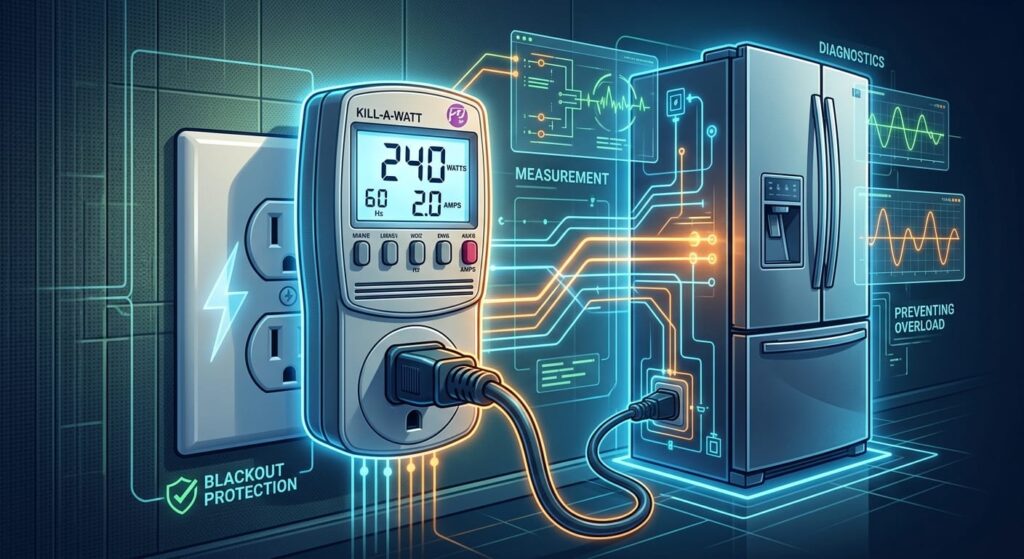
The quickest way to crash an emergency backup setup is guessing your appliance wattages. Many full-size refrigerators have modest running ratings but pull massive inductive surges when their cooling compressors kick in, instantly tripping small inverters.
👉 Check Price on Amazon – Digital Power & Wattage Meter
Why It’s Essential
You cannot manage what you do not measure. A digital inline power meter plugs between any wall outlet and your household appliances, instantly exposing continuous running watts, peak starting surge watts, volt-amps, and cumulative energy consumption (kWh) over time.
The Diagnostic Benefit
- Surge Detection: Pinpoint the exact 500W to 1200W starting surge of your refrigerator or sump pump to ensure it fits within your power station’s inverter surge rating.
- Duty Cycle Profiling: Measure true 24-hour kilowatt-hour usage on appliances that cycle intermittently (like freezers and chest coolers) to budget accurate battery sizing.
- Phantom Load Identification: Uncover hidden 5W to 20W standby vampire draws on modern TVs, game consoles, and microwave clocks before they drain your emergency storage.
Key Pros & Field Takeaways
- Multi-Parameter LCD Display: Real-time monitoring of Watts, Volts, Amps, Frequency (Hz), Power Factor, and Total kWh.
- Overload Warning Alerts: Configurable wattage alarms warn you when an appliance exceeds safe operational thresholds.
- Pre-Storm Staging Tool: Bench test your home appliances well before severe weather arrives to construct an accurate emergency load-shedding schedule.
4. Heavy-Duty 12V Cigarette Socket Extension & Splitter ($14 – $18)
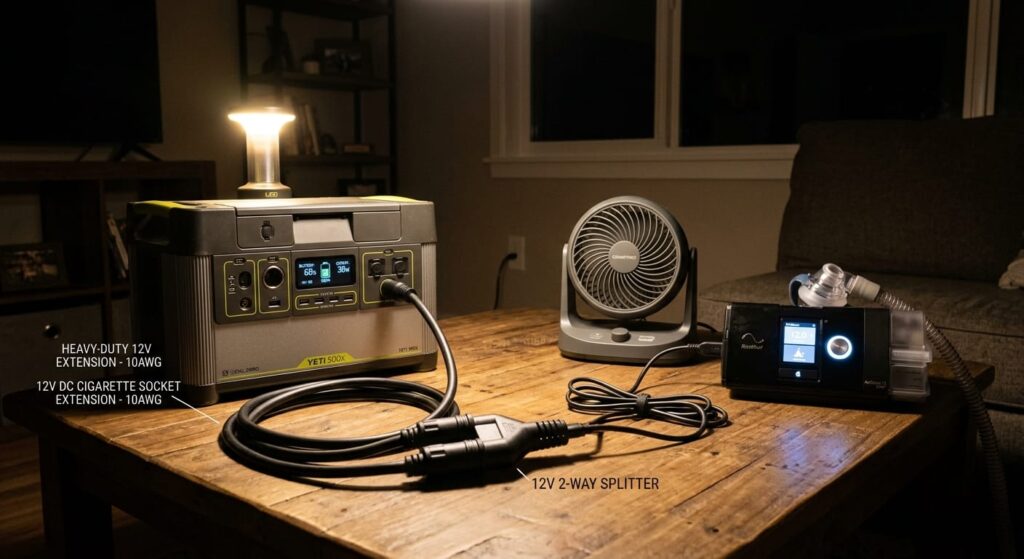
Power stations are bulky, heavy, and often stored in centralized locations like utility rooms, garages, or kitchen corners. Running long 120V extension cords creates tripping hazards and forces you to run the AC inverter 24/7.
👉 Check Price on Amazon – 12V Fused Extension & 2-Way Splitter Cable
Why It’s Essential
Most modern portable power stations feature a regulated 12V/10A (120W) cigarette lighter socket. A heavy-gauge DC extension cable and multi-socket splitter lets you route native DC power directly to bedside CPAP units, 12V camping fans, and high-speed multi-port car chargers without incurring any inverter losses.
The Battery Savings
- Direct Multi-Device Operation: Run a 12V CPAP machine (15W–25W without humidifier), a 12V brushless tent fan (4W–8W), and a 12V multi-port USB-C PD charger (30W) concurrently from a single battery output port.
- Zero Standby Overhead: Eliminates the continuous 15W to 25W AC idle loss generated when running 120V extension cords across your home.
- Minimal Line Resistance: Heavy-gauge wiring prevents the voltage drops that trigger low-voltage cutoffs on 12V portable refrigerators and medical devices.
Key Pros & Field Takeaways
- Heavy-Duty 14AWG to 16AWG Pure Copper Wiring: Built to handle continuous 10A to 15A loads (120W–180W) without thermal throttling or voltage drop.
- Inline Fuse Safety: Built-in 15A glass/blade fuses and weather-resistant dust caps protect sensitive electronics from short circuits.
- 10- to 15-Foot Reach: Route native 12V DC power straight to bedside nightstands, work desks, or sleeping quarters with ease.
5. Fused Alligator Clip to 12V Cigarette Socket Harness ($10 – $14)
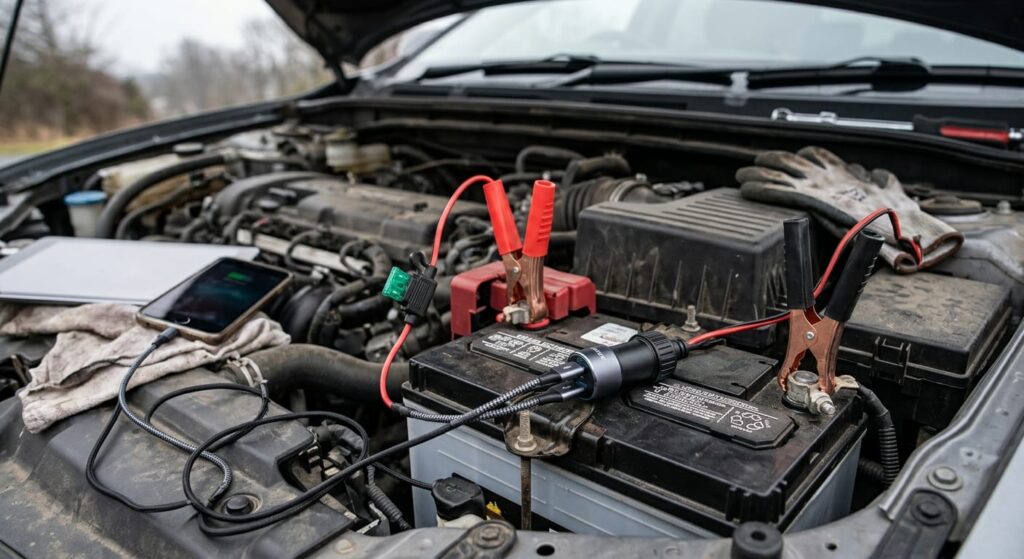
When a prolonged blackout outlasts your primary lithium power station and cloudy skies prevent solar recharging, you need a way to tap alternative DC reserves stored around your property.
👉 Check Price on Amazon – Fused 12V Battery Clip Adapter
Why It’s Essential
This harness is the ultimate low-cost fallback tool. It features heavy-duty spring-loaded battery clamps on one end and a regulated 12V female cigarette socket on the other, allowing you to instantly tap into any standard lead-acid, AGM, or lithium battery from a vehicle, riding lawnmower, boat, or golf cart.
The Operational Benefit
- Access Hidden Reserves: A standard automotive or marine battery stores between 400Wh and 1,000Wh of nominal energy.
- Instant Emergency Hub: Clamp directly to a spare vehicle or marine battery, plug in a standard 12V multi-port USB-C car charger, and create an instant high-output charging station for flashlights, phones, tablets, and two-way radios.
- Critical Medical Lifeline: Provides an emergency DC power source for 12V-compatible CPAP devices during extended grid failures when your primary battery banks are exhausted.
Key Pros & Field Takeaways
- Inline Blade Fuse Protection: Includes a replaceable 15A/20A ATC inline fuse to protect wiring and devices from accidental short circuits or polarity spikes.
- Universal Terminal Compatibility: Heavy-duty, color-coded copper-plated alligator clips clamp securely onto top-post, side-post, and stud-style battery terminals.
- Compact Glovebox Size: Stashes flat inside any glove box, tool drawer, or storm kit bag for zero-footprint storage.
Quick Comparison Matrix: Inverter Power vs. Direct DC Efficiency
Here is how common blackout loads compare when powered through a typical 120V AC power station inverter versus running directly on native DC accessories:
| Emergency Device | Power Draw via 120V AC Inverter | Power Draw via Direct DC Cable | True Runtime Multiplier | Bench Test Note |
|---|---|---|---|---|
| Home Wi-Fi Router & ONT | 28W – 35W (9W load + ~20W inverter loss) | 7W – 9W (via 12V USB step-up cable) | ~3.5x to 4x Longer | Keeps home internet active for days on compact power banks. |
| Bedside / Living Room Light | 24W – 30W (9W LED bulb + ~18W inverter loss) | 3W – 5W (via 5V USB hanging LED bulb) | ~5x to 6x Longer | Soft ambient illumination with zero inverter fan noise. |
| CPAP Machine (No Humidity) | 40W – 55W (25W machine + ~20W inverter loss) | 18W – 25W (via native 12V DC adapter cord) | ~2x to 2.5x Longer | Crucial for extending battery life through multi-day outages. |
| Dual Smartphone Fast Charging | 35W – 45W (18W charging + ~20W inverter loss) | 19W – 22W (via 12V DC / USB-C PD socket) | ~1.8x to 2x Longer | High-speed fast charging without wasting standby energy. |
Internal Interlinking & Next Steps
Upgrading your storm kit with low-cost DC cables eliminates unnecessary inverter drain and keeps your most critical gear running when the grid fails. To further optimize your backup power strategy, explore our related field guides:
- Medical Emergency Prep: Step-by-step wiring and safety guidelines for running vital equipment can be found in our comprehensive guide on [how to run a CPAP machine off-grid].
- Daytime Energy Harvesting: Keep your auxiliary battery banks topped off between storms with our tutorial on how to charge a power bank with a solar panel.
- Storm Sequencing & Load Shedding: For full multi-day outage preparation, load prioritization, and power station runtime staging, read our complete hurricane blackout survival guide.
Leave a Reply