⚡ The 30-Second Bottom Line
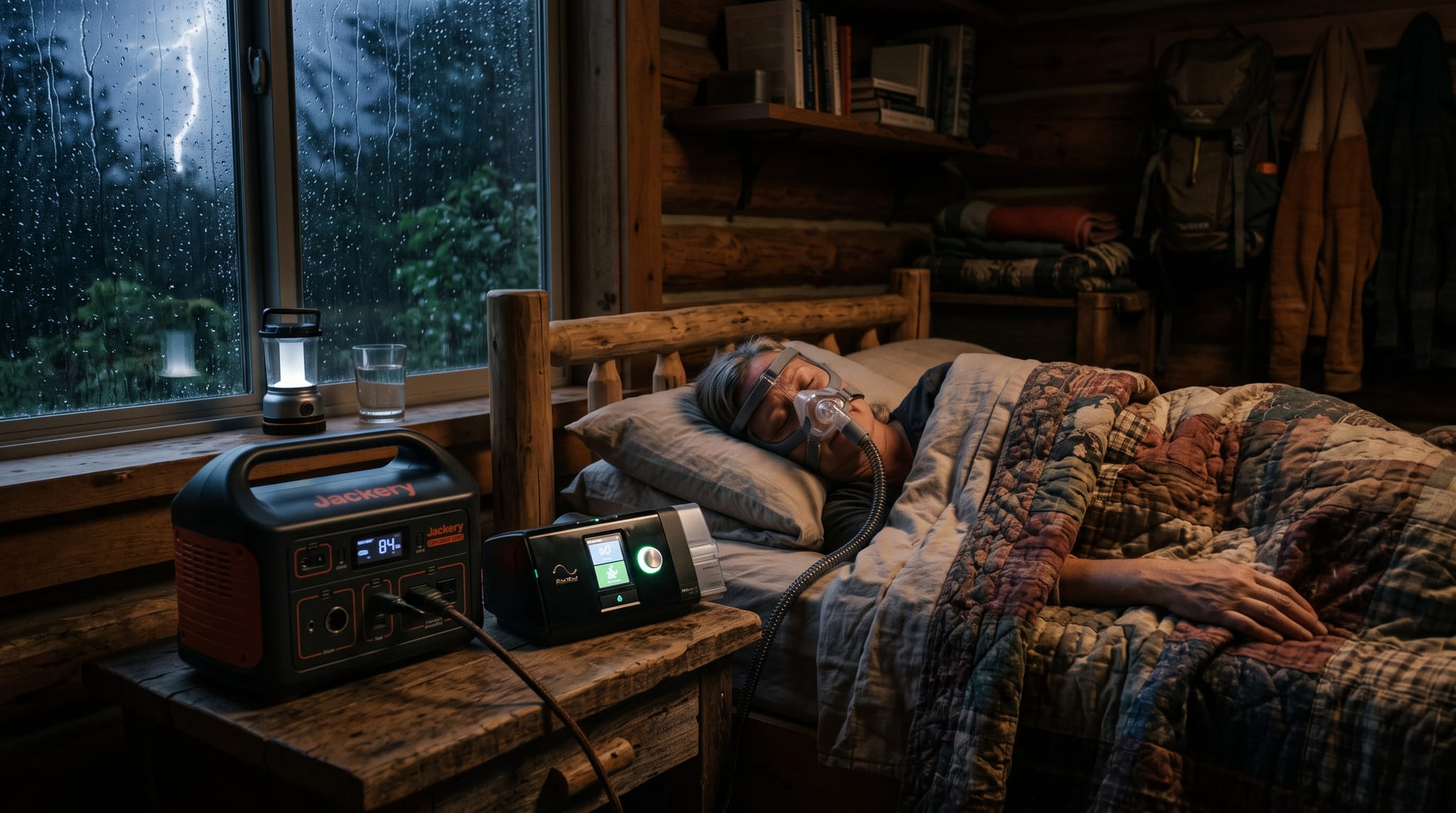
A standard CPAP, off-grid, needs only 8W to 15W to keep you breathing all night—IF you turn off the heat and bypass the wall plug inverter. Running on direct DC with heated humidification disabled drops your power draw by up to 85%. That means a compact 300Wh station delivers 3 full nights of sleep, a 500Wh station delivers ~5 nights, and a 1,000Wh station powers your machine for over a full week.
To successfully run CPAP off-grid during an extended storm blackout or remote camping trip, you cannot treat a portable power station like a standard household wall outlet. If you plug directly into an AC socket with factory humidification running, your battery will die before sunrise.
Follow these three non-negotiable power rules to stretch your emergency runtime from hours to weeks.
Secret 1: Kill the CPAP Heater (Do This: Save 75% Battery Draw off-grid.)
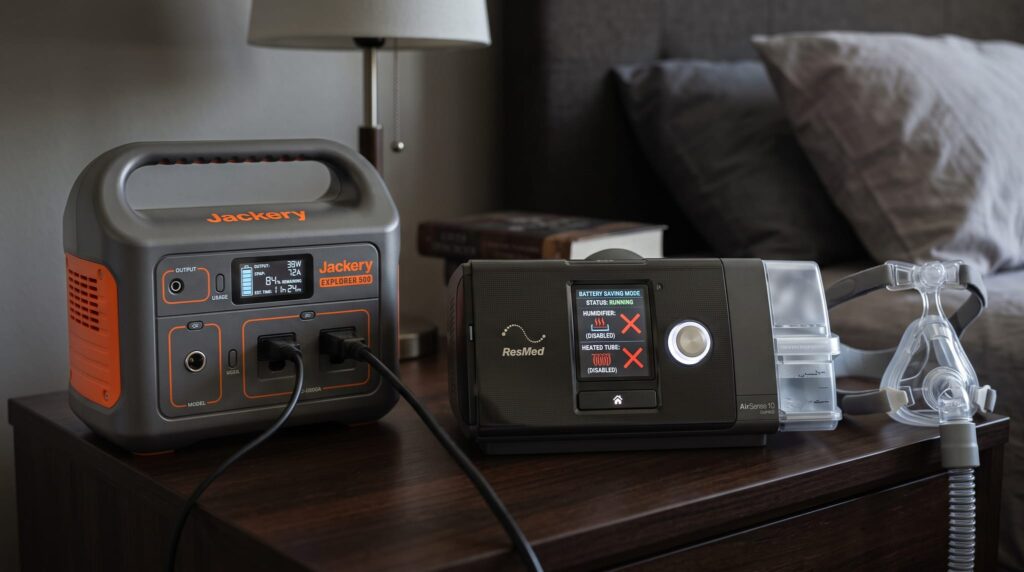
- The Problem: The heated humidifier and heated climate-line tubing pull 40W to 70W+ continuously, with peak spikes hitting 90W–100W. That massive thermal load drains a standard 300Wh portable battery in under 4 to 6 hours.
- The Fix: Enter your machine’s clinical or comfort settings and turn Humidity Level to OFF and Tube Temp to OFF (or switch Climate Control from Auto to Manual → Off). If you require moisture to prevent dry nasal passages, use passive pass-through humidity: fill the water chamber with distilled water and leave the heating element turned completely off.
- The Result: Your machine’s power consumption plummets to just 8W to 15W (depending on your pressure setting, e.g., 8–14 cm H2O). Disabling the heater instantly multiplies your off-grid battery runtime by 4x to 6x.
Power Draw Comparison: Active Heat vs. Pass-Through Air
- Full Climate Control (Heated Humidifier + Heated Hose): 50W–80W average → Drains 400Wh–640Wh per 8-hour night.
- Humidifier Only (Level 2–3, No Heated Hose): 25W–35W average → Drains 200Wh–280Wh per 8-hour night.
- Blower Fan Only (Heat & Heated Tube OFF): 8W–15W average → Drains 64Wh–120Wh per 8-hour night.
Secret 2: Ditch the CPAP AC Wall Plug (Do This: Stop 20% Inverter Waste, off-grid)
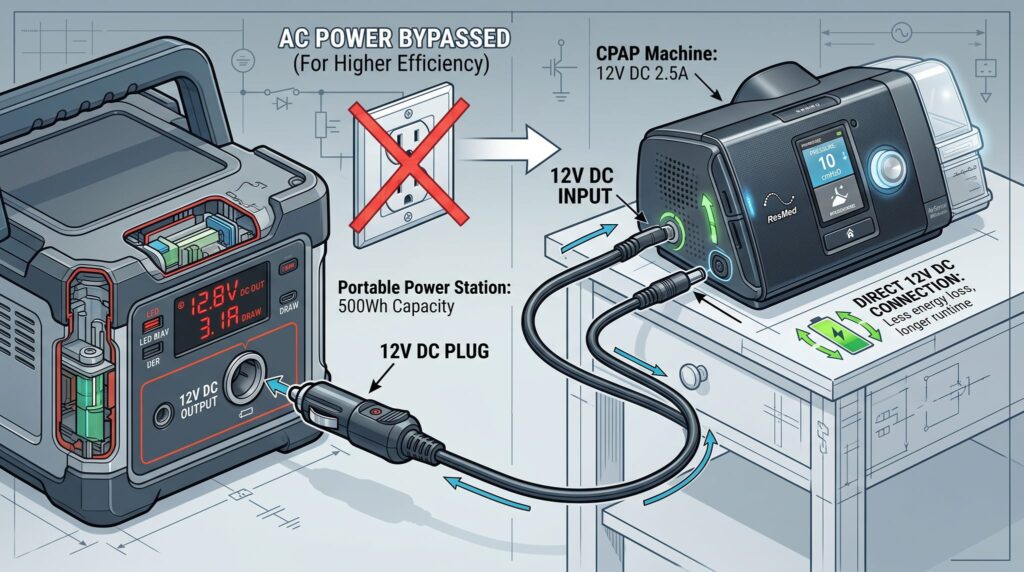
- The Problem: Your CPAP machine operates internally on low-voltage DC power (typically 12V or 24V). When you plug the standard AC brick into a power station’s 120V wall plug, the battery must convert DC battery power → 120V AC → 24V DC machine power. This double conversion forces the power station’s internal AC inverter to stay active all night, wasting 15% to 25% of your total battery capacity in pure heat and idle drain.
- The Fix: Purchase a dedicated 12V / 24V DC shielded converter cable tailored specifically to your machine model (such as the ResMed AirSense 10, AirSense 11, or Philips Respironics DreamStation). Plug directly into your power station’s regulated 12V cigarette lighter port or high-wattage USB-C PD port.
- The Result: Direct DC-to-DC power transmission eliminates inverter conversion loss entirely, running at 95%+ electrical efficiency. This single swap adds 1 to 2 extra full nights of sleep on the exact same battery charge.
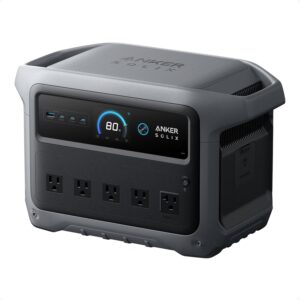
Is The New Anker SOLIX C1000 Gen 2 the Best Home Backup Generator?
Verified 12V / 24V DC CPAP Adapter Quick-List / Links to purchase below:
ResMed AirSense 10 & AirCurve 10: Requires a dedicated 12V-to-24V DC Step-Up Converter (ResMed Part #37297 or compatible shielded 24V adapter).
👉 [Check Price on Amazon: ResMed AirSense 10 DC Converter Cable]
React Health (3B Medical) Luna G3 Series: Operates natively on 24V DC using a dedicated barrel-style input connector. Requires a dedicated 12V-to-24V DC step-up shielded adapter cord (or manufacturer-compatible 24V car adapter cable) to run from a standard 12V auxiliary/cigarette port without activating the AC inverter. Like the AirSense series, turning off the integrated heated chamber and heated tubing reduces power draw from ~50W–65W down to just 9W–14W, multiplying your battery runtime by 4x to 5x.
👉 [Check Price on Amazon: React Health Luna G3 24V DC Power Adapter Cable]
ResMed AirSense 11 & AirMini: Requires a 65W+ USB-C PD to 24V trigger cable or the official 12V/24V DC power cord (ResMed Part #39205 / #39231).
👉 [Check Price on Amazon: ResMed AirSense 11 DC / USB-C Converter]
Philips Respironics DreamStation (1 & 2): Operates natively on 12V DC; requires a standard shielded 12V automotive power cord (Philips Part #1120746).
👉 [Check Price on Amazon: Philips DreamStation 12V DC Power Cord]
DIY Deep-Cycle Battery Harness: Heavy-duty fused alligator battery clamp to 12V female cigarette socket cable (for direct connection to marine/sealed AGM batteries).
👉 [Check Price on Amazon: 12V Fused Battery Clamp Adapter]
Secret 3: Calculate Your Real Nights of Sleep with your CPAP off-grid (The Exact Math)
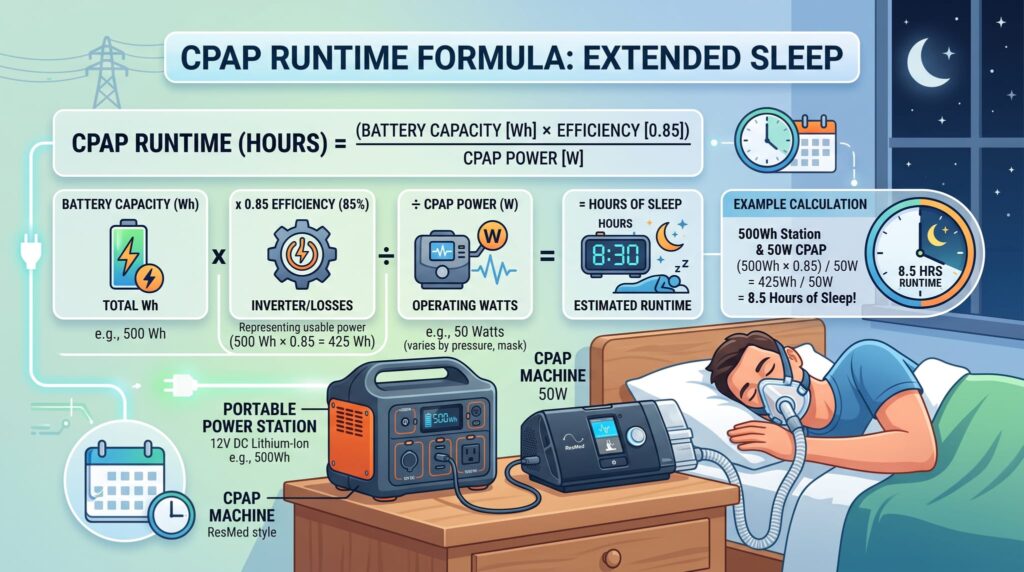
Never guess how long your backup will last when preparing to run CPAP off grid. Use our verified field formula to calculate your exact runtime before the grid goes down.
The Real-World Off-Grid CPAP Formula
Hours of Sleep = (Station Battery Capacity (Wh) × 0.85) ÷ Continuous CPAP Watts
(Note: The 0.85 multiplier accounts for standard battery depth-of-discharge limits, line resistance, and safety margins.)
Example Calculation (500Wh Station, DC Mode, Heat Off at 10W):
(500Wh × 0.85) ÷ 10W = 42.5 Usable Hours
42.5 Hours ÷ 8 Hours per Night = 5.3 Full Nights of Sleep
The 3 Core Off-Grid Battery Tiers (At 8 Hours/Night, DC Mode, Heat Off)
- 300Wh Power Station (Ultralight / Weekend Camping):
- Usable Capacity: ~255Wh
- Continuous Draw: 10W average
- Runtime: 25.5 Hours ≈ 3 Full Nights
- Best For: Weekend tent camping, bug-out bags, and 48-hour localized grid flickers.
- 500Wh Power Station (Short Outages / Extended Camp):
- Usable Capacity: ~425Wh
- Continuous Draw: 10W average
- Runtime: 42.5 Hours ≈ 5 Full Nights
- Best For: Multi-day severe weather alerts and road-trip overlanding.
- 1,000Wh Power Station (Multi-Day Hurricane / Major Blackout):
- Usable Capacity: ~850Wh
- Continuous Draw: 10W average
- Runtime: 85 Hours ≈ 10+ Full Nights
- Best For: Extended natural disaster backup, hurricane season readiness, and complete off-grid cabin setups.
Is The New Anker SOLIX C1000 Gen 2 the Best Home Backup Generator?
Quick Reference Matrix: CPAP Runtime Cheat Sheet
The table below outlines real-world runtimes across standard battery sizes based on an 8-hour sleep cycle with pressure set to 10 cm H2O:
| Power Station Capacity | Connection Mode | Climate / Heat Setting | Average Watt Draw | Total Usable Hours | Total Nights Delivered |
|---|---|---|---|---|---|
| 300Wh | AC Inverter | Heated (Humidifier + Hose ON) | 65W | ~3.9 Hours | < 0.5 Nights (Fails overnight) |
| 300Wh | AC Inverter | Unheated (Heat & Tube OFF) | 15W | ~17.0 Hours | 2.1 Nights |
| 300Wh | Direct 12V DC | Unheated (Heat & Tube OFF) | 10W | 25.5 Hours | 3.2 Nights |
| 500Wh | AC Inverter | Heated (Humidifier + Hose ON) | 65W | ~6.5 Hours | 0.8 Nights (Drains before wake-up) |
| 500Wh | AC Inverter | Unheated (Heat & Tube OFF) | 15W | ~28.3 Hours | 3.5 Nights |
| 500Wh | Direct 12V DC | Unheated (Heat & Tube OFF) | 10W | 42.5 Hours | 5.3 Nights |
| 1,000Wh | AC Inverter | Heated (Humidifier + Hose ON) | 65W | ~13.0 Hours | 1.6 Nights |
| 1,000Wh | AC Inverter | Unheated (Heat & Tube OFF) | 15W | ~56.6 Hours | 7.0 Nights |
| 1,000Wh | Direct 12V DC | Unheated (Heat & Tube OFF) | 10W | 85.0 Hours | 10.6 Nights |
The 2-Minute Pre-Storm CPAP Action Plan
When severe weather approaches, complete this 4-step checklist before the utility lines go dark:
- Step 1: Top off your power station to 100% capacity. Do not let lithium batteries sit at 50% storage voltage when storm warnings are active.
- Step 2: Dry-test your 12V DC converter cable. Connect your CPAP to the battery via the 12V DC cable and run a 2-minute mask-fit test to confirm the 12V port regulates voltage properly under pressure.
- Step 3: Manually fill the water chamber for passive humidification. Add distilled water to the tank, but leave the electronic heater plate disconnected and turned off in settings.
- Step 4: Lock machine climate controls to Manual / Off. Disable Auto-Climate features on ResMed/DreamStation units to guarantee the internal heating coil does not activate automatically mid-sleep.
Need Endless Off-Grid Power?
- For full-house emergency circuits, medical refrigeration, and critical device sequencing, review our hurricane blackout survival guide.
- To continuously replenish your power station during extended daytime outages, follow our complete guide on how to charge a power bank with a solar panel.
Leave a Reply