5 Crucial Off-Grid Power Accessories Under $100 for Emergency Preparedness and Field Reliability
In an extended blackout, off-grid expedition, or severe weather emergency, a high-capacity portable power station is only as useful as the accessories that keep it connected, charged, and functional. While many survivalists spend heavily on multi-kilowatt-hour battery banks, the real single point of failure in field operations usually occurs at the periphery: dead communications gear, inefficient power conversion, unrated weather seals, or lighting systems that drain primary battery banks overnight.
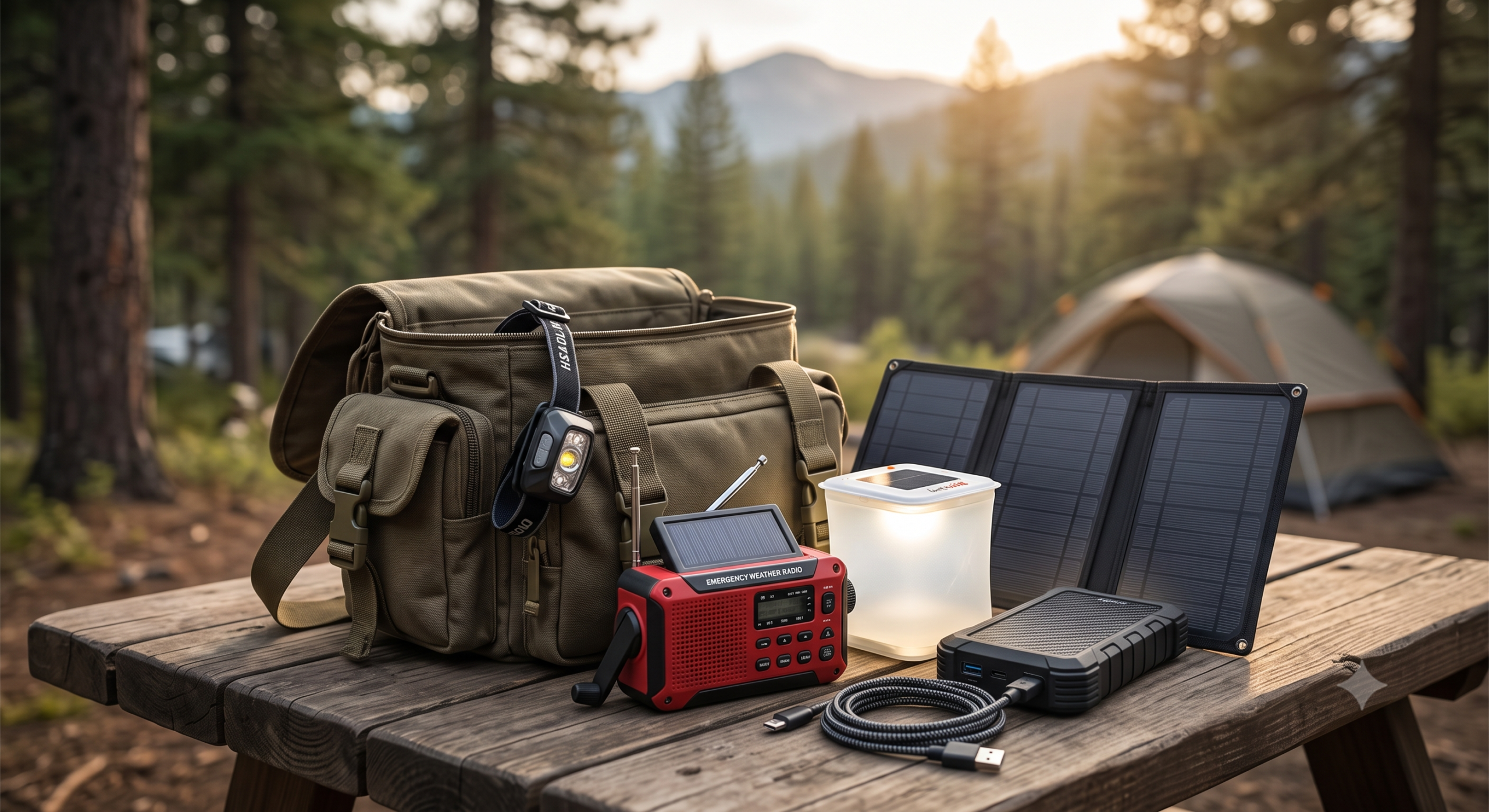
Deploying smaller, localized power accessories creates redundancy across your entire setup. Decentralized gear—such as self-contained solar lanterns, emergency radios with manual hand cranks, high-efficiency portable PV panels, and ultra-lightweight weatherized power banks—ensures that critical tasks like tactical lighting, NOAA weather tracking, and device charging remain operational even if a central power hub fails.
Check out more POWERFUL Off-Grid Watts content by clicking here!
Technical Breakdown: Understanding Off-Grid Electrical Metrics & Field Standards
Before investing in compact power accessories, evaluating gear against standardized technical metrics ensures survival utility rather than market hype.
Ingress Protection (IP) Ratings
For outdoor gear, water and dust protection are defined by the IEC standard 60529. An IP rating consists of two numbers (e.g., IP67):
- First Digit (Solids): Ranges from 0 to 6. A rating of 5 indicates dust protection, while 6 guarantees full dust-tight containment.
- Second Digit (Liquids): Ranges from 0 to 9. A rating of 4 protects against splashing water from any direction, 5 or 6 against low/high-pressure water jets, 7 against temporary immersion up to 1 meter for 30 minutes, and 8 against continuous submersion under pressure.
- IPX Rating: When an “X” replaces a digit (e.g., IPX4 or IPX5), the product has not been formally tested for solid particle ingress, but offers verified liquid protection against splashes or rain.
Solar Panel Conversion Efficiency & Real-World Output
Solar panel efficiency indicates the percentage of sunlight hitting the solar cells that is converted into usable electricity under Standard Test Conditions (STC: 1,000 W/m² irradiance, 25°C cell temperature, AM 1.5 air mass spectrum).
- Monocrystalline Silicon: Offers the highest efficiency (typically 21% to 24%), converting more energy per square inch, making it the gold standard for portable panels.
- Polycrystalline Silicon: Lower efficiency (15% to 18%) and larger footprint for equivalent wattage.
- Real-World Yield: Compact panels rarely achieve STC ratings in field environments. Heat buildup increases internal cell resistance (temperature coefficient around -0.35%/°C to -0.45%/°C above 25°C), while non-optimal tilt angles, cloud cover, atmospheric haze, and dirty lenses further reduce actual power generation to roughly 60%–75% of rated peak wattage.
Battery Chemistries & Self-Discharge Dynamics
- Lithium-Ion (NMC/LCO): Delivers high energy density by weight and volume, ideal for compact power banks and portable radios. However, standard Li-ion cells experience moderate self-discharge (roughly 2%–3% per month) and degrade faster when stored at 100% state of charge in ambient temperatures above 30°C.
- Lithium Iron Phosphate (LiFePO4): Exceptional thermal and chemical stability, 2,000 to 3,500+ charge cycles, and low self-discharge, though heavier per watt-hour.
- Nickel-Metal Hydride (NiMH): Frequently found in AA/AAA emergency systems. Standard NiMH suffers high self-discharge (up to 20% in the first month), whereas Low Self-Discharge (LSD) NiMH retains up to 70%–85% capacity after one year of storage.
Voltage Regulation & Pass-Through Charging
Small solar panels generate fluctuating DC voltage depending on sunlight conditions. Integrated USB controllers must apply strict buck voltage regulation to stabilize output to standard 5V/9V/12V bus limits, preventing connected smartphones or power banks from entering charge-reset loops. Furthermore, pass-through charging allows an accessory battery to receive incoming solar power while simultaneously outputting regulated current to external loads
Product Recommendations
Midland ER310 Emergency Crank Weather Radio
Why We Recommend It
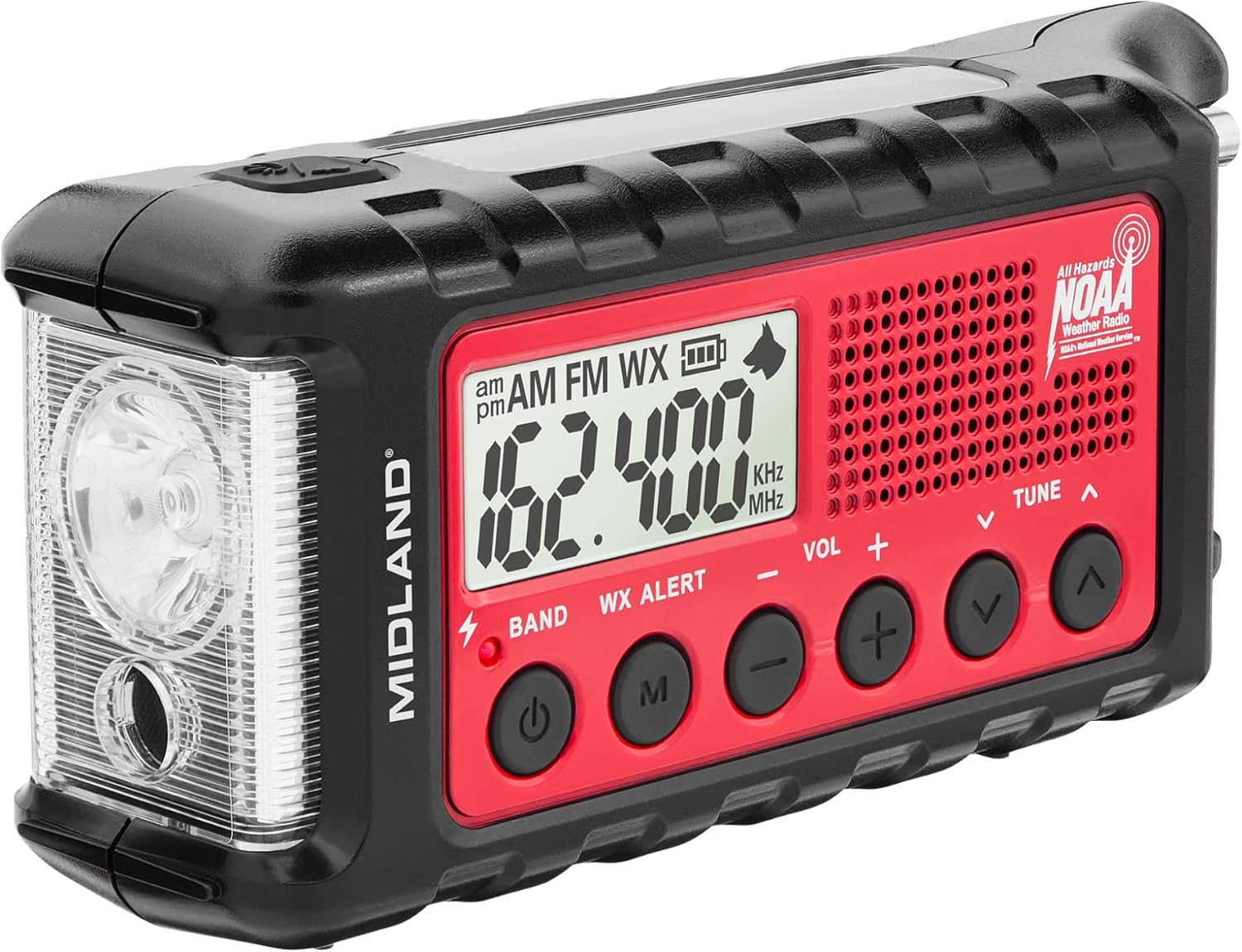
The Midland ER310 is a self-contained emergency comms hub designed for blackouts and disaster response. It incorporates multiple redundant power inputs: a hand crank, a built-in top-mounted solar panel, a replaceable 2600 mAh 18650 Li-ion battery, and an optional backup compartment for standard AA batteries. Beyond receiving standard AM/FM stations and 7 NOAA weather bands with automated alert warnings, the ER310 acts as an emergency flashlight (with an ultrasonic dog whistle feature for search-and-rescue visibility) and includes a USB-A port to trickle-charge essential mobile devices.
Key Specs
- Power Sources: Hand crank dynamo, solar panel, 2600 mAh Li-ion (18650), 6x AA battery backup (not included)
- Radio Bands: AM, FM, 7 NOAA Weather Channels with NOAA Weather Alert
- Outputs: 5V 0.75A USB-A charging port, 3.5mm headphone jack
- Lighting: Cree LED flashlight with low, high, and SOS strobe modes
- Weight: 1.0 lbs (454 g)
Pros & Cons
- Pros:
- Multiple redundant charging inputs ensure operation under zero-grid conditions.
- Uses standard, user-replaceable 18650 Li-ion battery geometry.
- Direct NOAA weather alert monitoring alerts users during sudden weather events.
- Cons:
- USB output speed (0.75A/3.75W) is slow for modern fast-charging smartphones.
- Integrated solar panel is small and suitable primarily for maintenance charging.
LuminAID PackLite Max 2-in-1 Power Lantern
Why We Recommend It
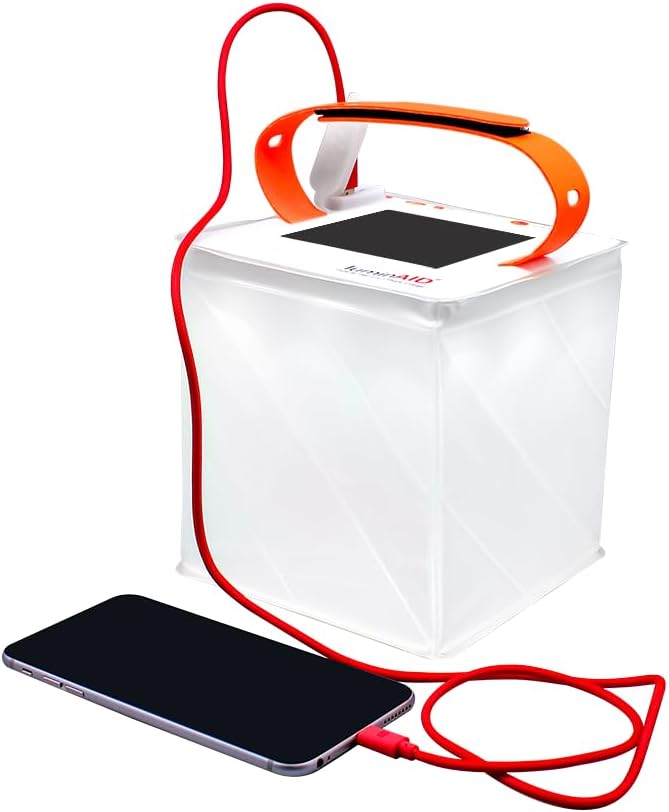
Relying on high-draw floodlights drains central battery power quickly. The LuminAID PackLite Max provides decentralized area lighting by using an inflatable TPU diffuser that collapses down to a 1-inch thick profile for packing. It delivers up to 150 lumens of warm lighting across 40 square meters without creating harsh glare or hot spots. With an IP67 waterproof and floatable construction, it recharges via its top-mounted high-efficiency solar panel or Micro-USB, while providing a 2000 mAh internal battery reserve to top off communications gear in camp.
Key Specs
- Light Output: 150 lumens (Max), 5 brightness modes including Turbo and SOS
- Battery Capacity: 2000 mAh internal Lithium-ion
- Waterproofing: IP67 (Dust-tight, submersible to 1m, floats on water)
- Recharge Time: ~12-14 hours via built-in solar; ~1-2 hours via USB
- Weight: 8.6 oz (244 g)
Pros & Cons
- Pros:
- IP67 rating and floating structure handle wet, extreme weather environments easily.
- Collapsible design maximizes space inside tactical or emergency bug-out packs.
- Diffused light pattern lights up tents or shelters without blinding users.
- Cons:
- Small internal battery (2000 mAh) limits phone charging to emergency top-offs.
- Takes a full day of direct, unshaded sunlight to fully recharge via built-in solar.
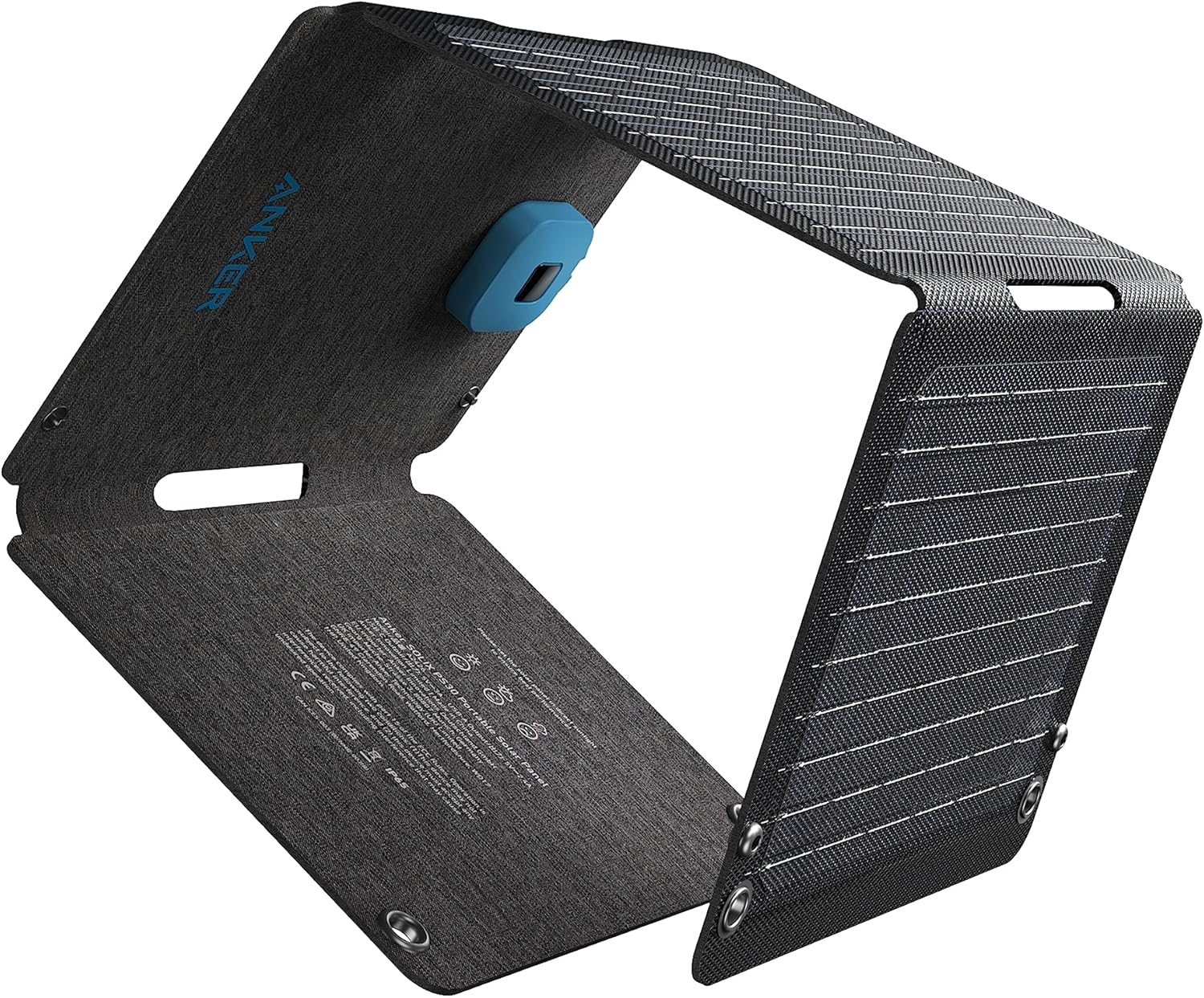
Anker 21W Dual USB Solar Charger
Why We Recommend It
When stationary power supplies are unavailable, a portable folding solar array allows off-grid power generation directly from sunlight. The Anker 21W Dual USB Solar Charger utilizes industrial-grade monocrystalline solar arrays bound in weather-resistant PET polymer and heavy-duty polyester canvas. Its integrated Smart IC PowerIQ technology regulates output voltage across two USB ports, preventing charge interruption caused by transient cloud cover. Four reinforced steel eyelets enable easy rigging to backpacks, shelters, or vehicles during field movements.
Key Specs
- Rated Wattage: 21 Watts (Peak)
- Solar Cell Type: Monocrystalline (~21.5%23.5% efficiency)
- Outputs: 2x USB-A (Up to 5V/2.4A per port or 3A total under direct sun)
- Dimensions: 11.1 6.3 in (folded); 26.4 11.1 in (unfolded)
- Weight: 14.7 oz (417 g)
Pros & Cons
- Pros:
- High-efficiency monocrystalline cells deliver strong power output relative to array area.
- Smart auto-reconnect technology prevents charging resets during passing clouds.
- Rugged canvas housing and stainless steel grommets offer dependable trail mounting.
- Cons:
- Lacks an internal battery bank; only charges external devices directly under active sunlight.
- USB junction box is weather-resistant but not fully submersible.
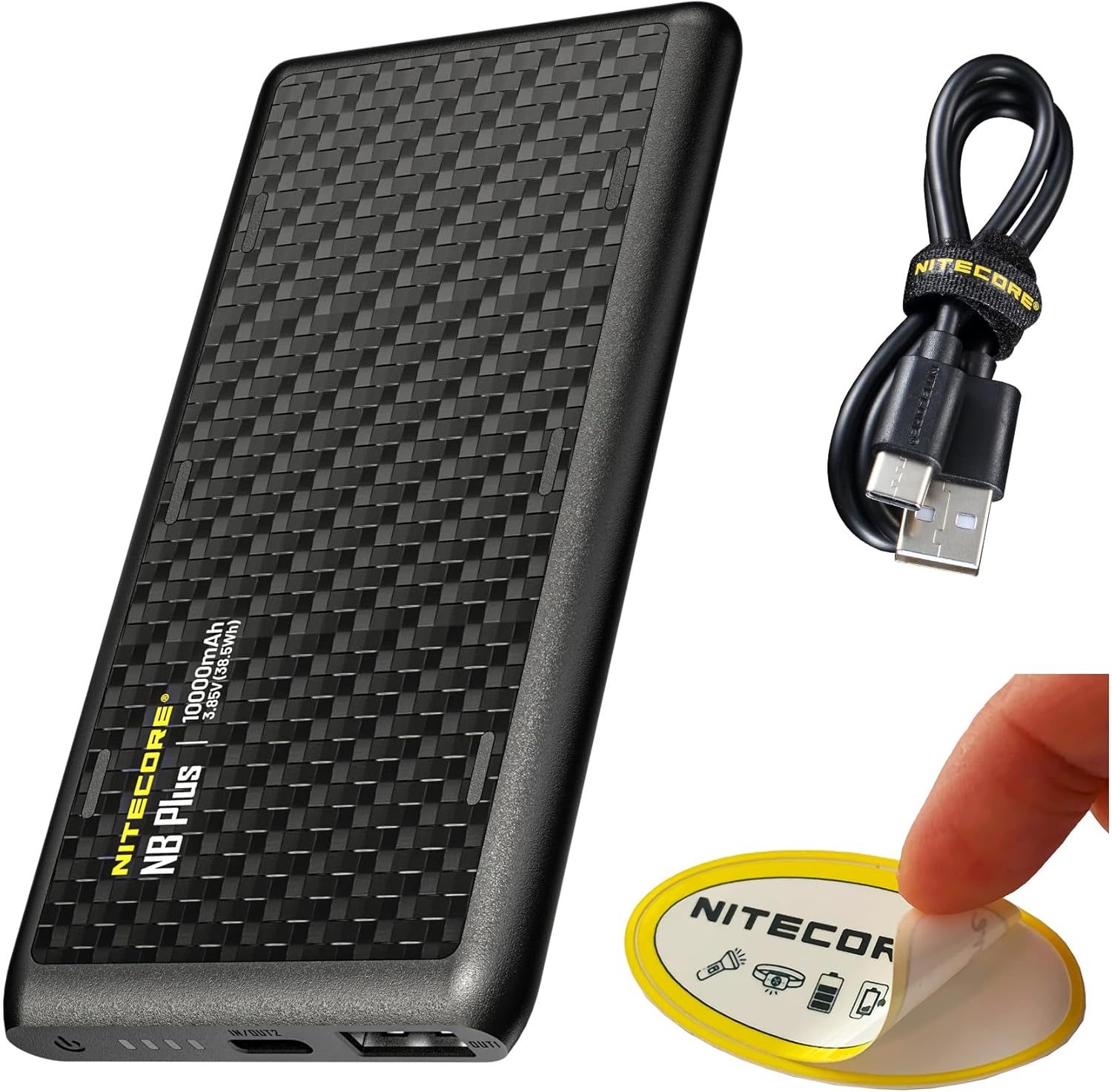
Nitecore NB10000 Gen 3 Power Bank
Why We Recommend It
Standard consumer power banks often lack environmental sealing and durability. Built specifically for ultra-light hikers and tactical operators, the Nitecore NB10000 Gen 3 features a lightweight carbon fiber reinforced frame that absorbs shocks and reduces weight by up to 40% compared to typical power banks. With a 10,000 mAh capacity, 22.5W USB-C PD fast charging, IPX5 water resistance, and a low-current mode for sensitive gear like headlamps and GPS watches, it serves as a lightweight, rugged energy buffer for individual off-grid operations.
Key Specs
- Capacity: 10,000 mAh (38.5 Wh, 3.85V)
- Input/Output: Dual USB-C ports (Up to 22.5W PD bi-directional output)
- Protection Class: IPX5 water resistant, 1.5-meter impact resistant
- Dimensions: 4.80 2.32 0.42 inches
- Weight: 5.29 oz (150 g)
Pros & Cons
- Pros:
- Carbon fiber housing provides high structural integrity at a low overall weight.
- Low-current mode safely charges small rechargeable accessories like headlamps.
- Dual USB-C fast charging supports modern phone and tablet power standards.
- Cons:
- Higher cost per milliamp-hour compared to standard plastic consumer power banks.
- Ultra-compact body dissipates heat quickly, but can feel warm during sustained 22.5W output.
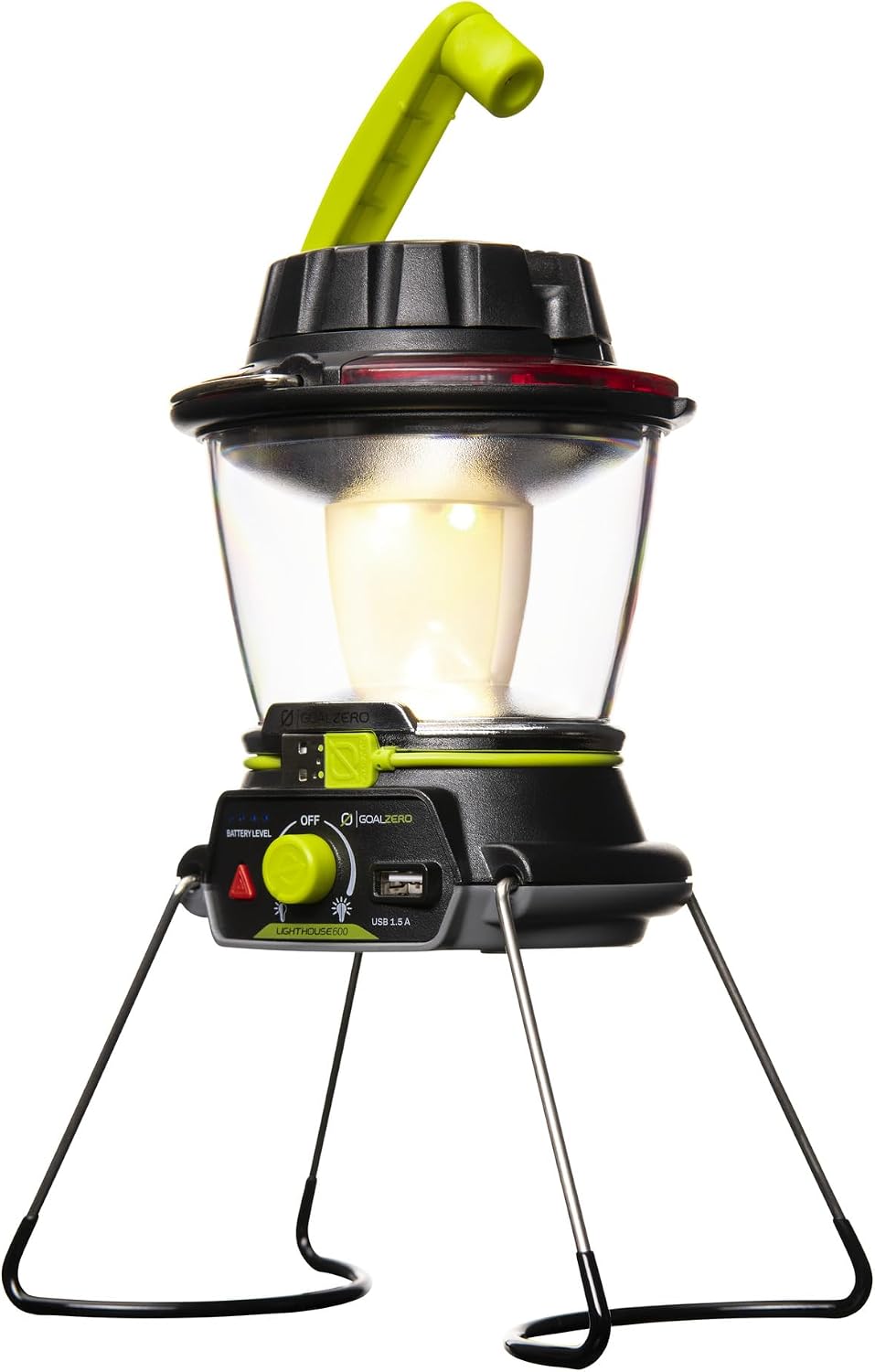
Goal Zero Lighthouse 600 Lantern & Power Hub
Why We Recommend It
The Goal Zero Lighthouse 600 combines multi-directional area lighting with emergency power bank capabilities and manual hand-crank charging. Delivering up to 600 lumens of adjustable warm LED illumination, it features directional lighting controls (180 or 360 selection) to conserve its internal 5200 mAh battery. Built-in folding legs elevate the lantern off wet surfaces to maximize light spread, while an integrated hand crank provides emergency mechanical power generation when solar or grid charging is unviable.
Key Specs
- Light Output: 600 Lumens (Max LED), Dimmable 180/360 mode selection
- Battery Capacity: 5200 mAh (18.7 Wh) internal Lithium-ion
- Power Inputs: Built-in USB charging cable (~3.5 hrs), integrated hand crank (1 min cranking = 10 mins light)
- Power Outputs: 5V up to 1.5A (7.5W max) USB-A port
- Weight: 1.1 lbs (498 g)
Pros & Cons
- Pros:
- Integrated hand crank offers a mechanical backup when solar arrays and grid power are unavailable.
- 180-degree directional lighting mode cuts power consumption in half for prolonged runtime.
- Sturdy folding legs elevate the light source for wider campsite coverage.
- Cons:
- USB output capped at 1.5A (7.5W), resulting in slower charge times for modern tablets.
- Bulkier footprint compared to inflatable or collapsible camp lighting options.
Buyer’s Guide & Tactical Selection Summary
Building an effective off-grid power setup requires selecting gear that matches your specific operational requirements:
| Operational Scenario | Recommended Primary Gear | Key Tactical Advantage |
|---|---|---|
| Grid Outage & Storm Preparedness | Midland ER310 Emergency Radio | Direct NOAA weather alert updates with hand-crank backup when all grid power fails. |
| Camp & Base Shelter Lighting | LuminAID PackLite Max Lantern | Glare-free, 360-degree area lighting that floats and operates independently of central power banks. |
| Extended Wilderness Hikes | Anker 21W Solar Panel + Nitecore NB10000 | On-the-go solar power capture stored into an ultra-lightweight carbon fiber battery buffer. |
| Minimalist Bug-Out Bag | Nitecore NB10000 Gen 3 Power Bank | Maximum energy density per ounce with IPX5 weather protection for individual device support. |
| Basecamp Area Illumination & Backup Power | Goal Zero Lighthouse 600 | 600-lumen adjustable output with folding legs and manual crank reserve. |
To maximize reliability, avoid relying on a single large power system. Combining localized solar generation, energy-dense lithium storage, and multi-fuel backup devices builds a resilient off-grid energy ecosystem capable of handling extended power disruptions.
Check out more POWERFUL Off-Grid Watts content by clicking here!
Leave a Reply