
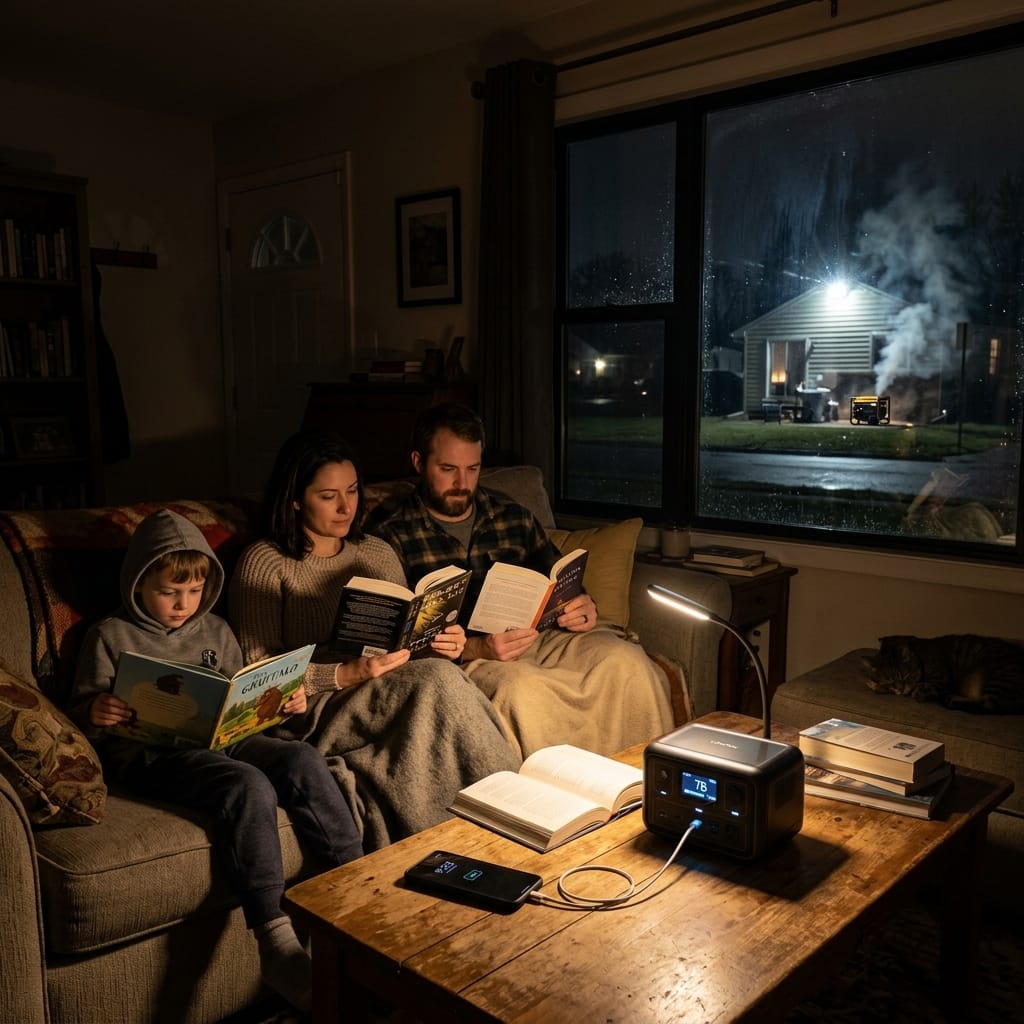
When a severe storm knocks out utility power for days, the neighborhood soundtrack is predictable: a chorus of roaring 5,000-watt gas generators.
For the first 12 hours, those homeowners feel secure.
By Day 4, the situation changes.
Local gas stations have either pumped their underground tanks dry or cannot pump at all because their credit card terminals and dispensers lack power. Homeowners are suddenly rationing five-gallon jerrycans in the dark, watching an engine burn half a gallon of fuel every single hour—just to power a few lights, a router, and a phone charger.
Oversized gas generators solve a specific problem (bulk power for central AC units and 240V well pumps), but for surviving an extended multi-day blackout comfortably, they carry severe operational vulnerabilities.
A modular, solid-state $300 micro-grid can comfortably outlast a $2,000 gas generator setup during a protracted disaster—without noise, fuel runs, or regular maintenance headaches.
The Dirty Secret of Generator “Standby Waste”
The fatal flaw of conventional gas generators during an emergency isn’t raw output—it’s standby consumption and idle waste.
An internal combustion generator engine must spin at 3,600 RPM to produce standard 60Hz utility AC power. While inverter-style gas generators throttle down under light loads, they still burn continuous baseline fuel simply keeping the engine running:
- A standard 4,500W open-frame generator burns roughly 0.4 to 0.6 gallons of gasoline per hour at 25% load.
- At $3.50 a gallon, keeping that generator running 16 hours a day costs $22 to $33 every 24 hours.
- Over a 7-day extended grid outage, that single generator consumes 45 to 65 gallons of fuel.
Unless you safely store ten or twelve 5-gallon cans treated with fuel stabilizer—and rotate that fuel every six months—your big generator will run dry long before line crews restore utility power.
Add stale fuel gumming up carburetors, required oil changes every 50 to 100 runtime hours, and the noise beacon drawing attention to your home, and gas power becomes a logistical liability.
The $300 Modular Micro-Grid Blueprint
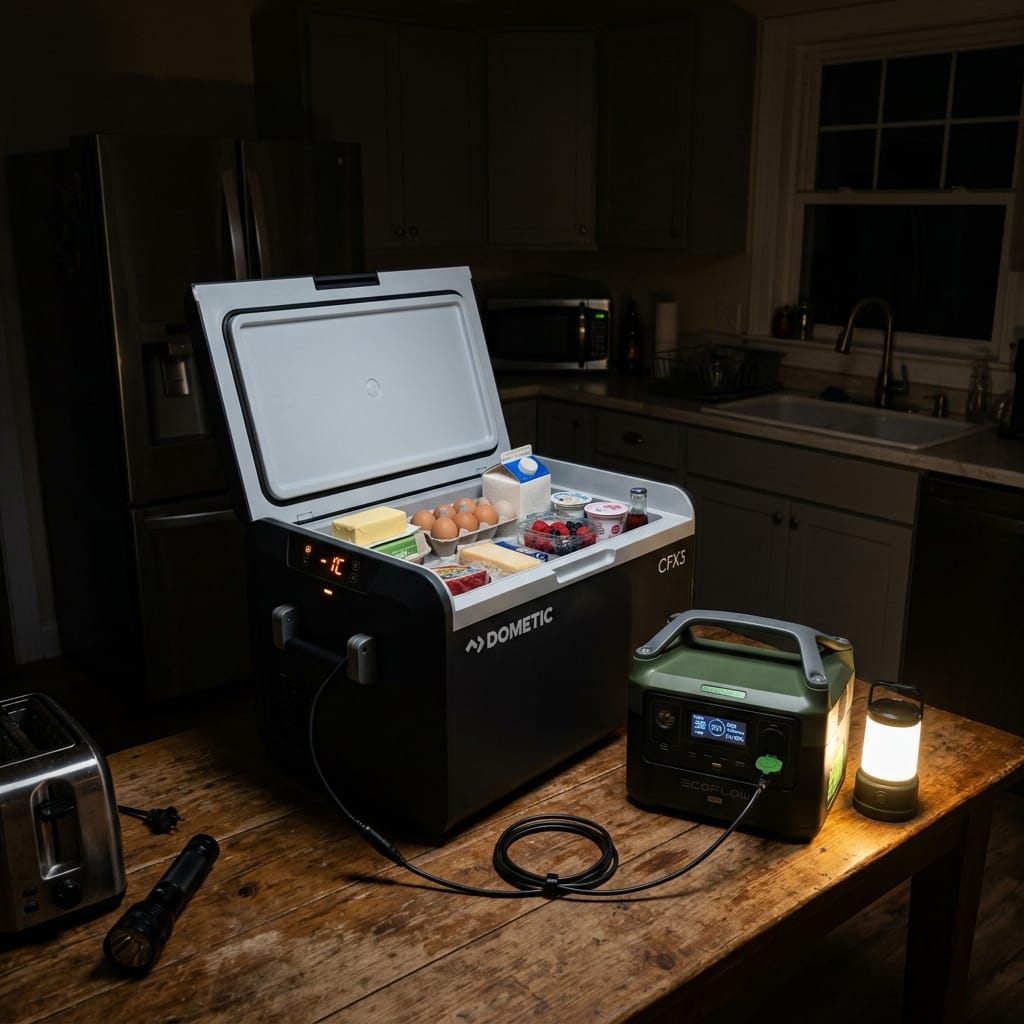
To survive an extended outage indefinitely, you don’t need to power your whole house like the grid never left. You need to keep your critical survival baseline energized 24 hours a day:
- Medical Gear & Critical Comms: CPAP machines, phones, emergency weather radios, two-way radios.
- Food Preservation: Running portable high-efficiency 12V compressor travel coolers or short cooling cycles on household freezers.
- Task & Area Lighting: Focused lumens for food prep, security checks, and sanitation without blinding glare.
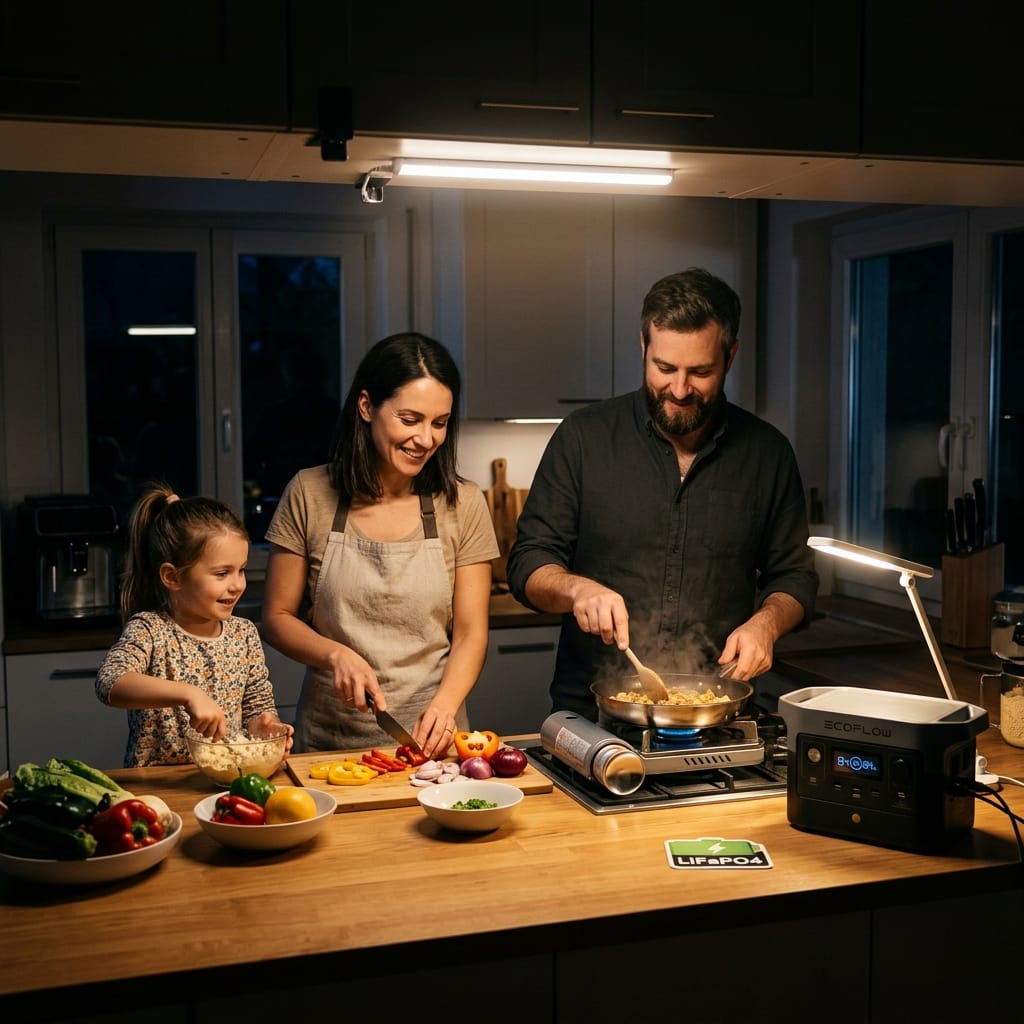
Here is the exact three-tier hardware breakdown to build this setup for roughly $300 using field-tested Amazon gear.
Component 1: The Core LiFePO4 Power Station ($140 – $180)
Older lithium-ion (NMC) power banks degrade after 500 charge cycles. Modern LiFePO4 (Lithium Iron Phosphate) cells handle 3,000+ full charge cycles down to 80% health. You can use it, store it, drain it, and recharge it daily for a decade without noticeable capacity loss.
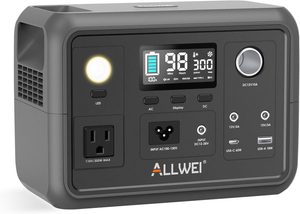
ALLWEI 300W Portable Power Station (256Wh LiFePO4)
The ideal budget entry point for strict sub-$300 micro-grids. It packs durable 3,000+ cycle LiFePO4 battery cells, a 300W pure sine wave AC inverter (600W surge), regulated 12V DC output, and an integrated MPPT solar controller that accepts standard 100W panels without extra adapters.
Check Price on Amazon →Component 2: The Renewable Fuel Source ($80 – $129)
Fuel lines run dry, but the sun comes up every morning. A quality 100W mono-crystalline folding panel pulls in 70W to 85W of real-world power through the power station’s MPPT controller, fully topping off a depleted 288Wh station in 4 to 5 hours of direct sunlight.
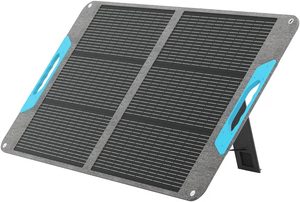
Renogy 100W Portable Foldable Solar Panel
Monocrystalline cells with an ETFE coating and adjustable kickstands that maximize sunlight collection even in partial cloud cover. It folds down into a durable carrying suitcase and connects directly to standard portable power stations via MC4 / DC adapter cables to fully recharge a 300Wh station in 4 to 5 peak sun hours.
Check Price on Amazon →Component 3: Direct DC Essentials ($30 – $40)
Every time you turn on a power station’s 120V AC wall plug, the internal inverter burns 10W to 25W just staying powered on. Bypassing the AC inverter and running your gear directly off native DC or USB-C boosts battery efficiency by 25% to 35%.
Direct DC Essentials
Bypassing your power station’s AC inverter preserves 25% to 35% more battery runtime. Plug directly into the 12V cigarette port using these low-draw accessories:
Select the dedicated cable that matches your specific machine:
Powers Wi-Fi modems and routers straight from USB-C ports.
Bright ambient/room light that draws only 2W to 4W of power.
3 Rules to Make 300Wh Outlast an 8,000Wh Gas Generator
If you plug a standard 1,500W space heater or a high-draw hair dryer into a 300Wh battery, it will shut down instantly on overload. The micro-grid strategy relies on smart energy management:
1. Batch High-Draw Tasks, Float Low-Draw Essentials
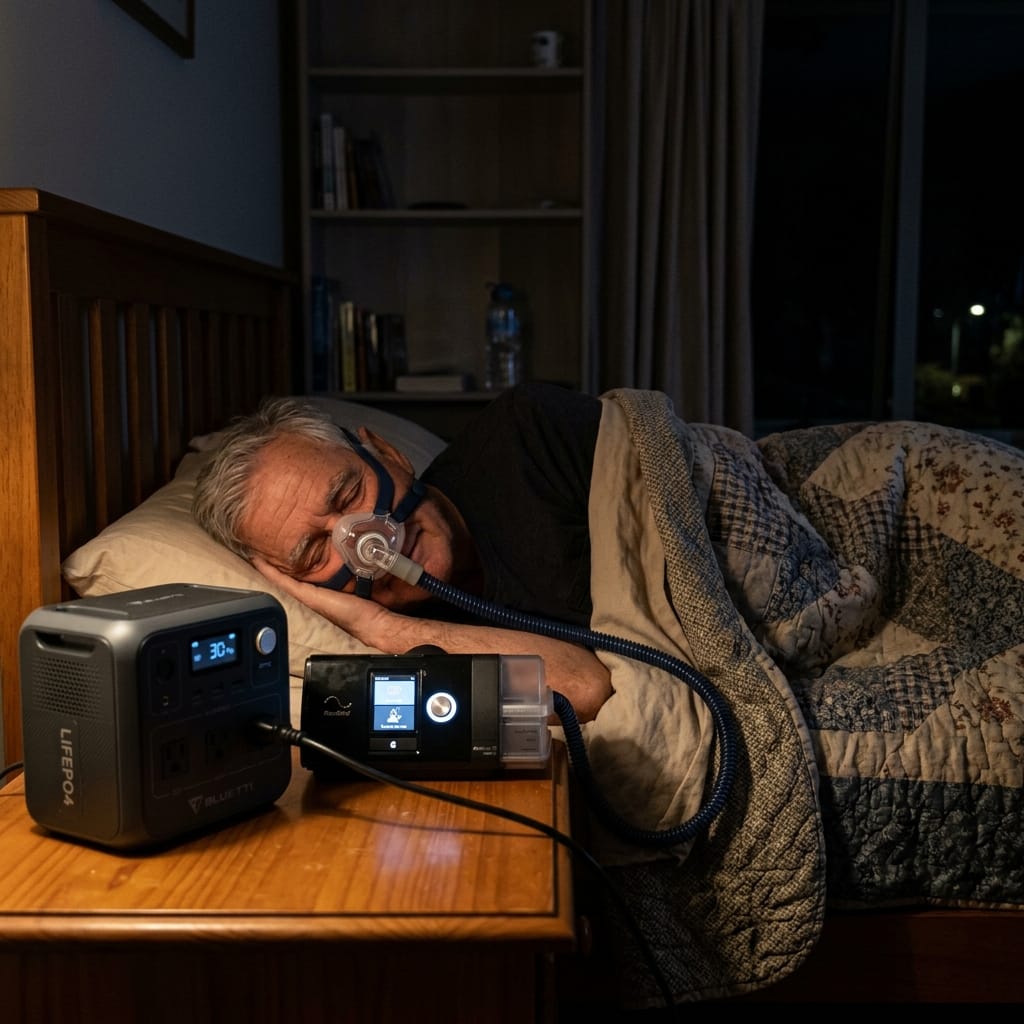
Never leave your battery’s AC switch turned “ON” overnight to power a cell phone. Charge your devices during the afternoon while the solar panel is actively pushing free wattage into the station. At night, switch the AC inverter OFF and rely strictly on native DC USB ports.
2. Bypass AC Power Bricks for Medical & Comms
If you run a CPAP machine off-grid, turn off the heated humidifier and heated tubing, and plug into the 12V DC port using an OEM 12V converter. Instead of drawing 60W–90W, the machine drops to an average draw of 8W–12W per hour—giving you two full 8-hour nights of sleep on a single charge before needing solar replenishment.
If you run a sleep therapy setup, never plug standard AC bricks into an inverter overnight. For a complete walkthrough on voltage requirements, cable adapters, and watt-hour calculations, check out our in-depth guide on how to run a CPAP machine off-grid safely.
3. Maintain Thermal Mass
For refrigeration, freeze 1-gallon water jugs solid before the storm hits. Transfer them to an insulated chest cooler alongside perishable medicines and dairy. A quality rotomolded cooler paired with cold ice packs eliminates the need to run an energy-hogging kitchen refrigerator compressor constantly.
The Verdict
Gas generators have their place for raw muscle—running well pumps, central AC compressors, or heavy shop tools. But when supply lines snap, roads close, and fuel stations go dark, reliance on continuous gasoline becomes a ticking clock.
A compact, 300Wh LiFePO4 battery paired with a 100W folding solar panel creates a self-sustaining survival loop. It operates silently inside your living room, produces zero toxic carbon monoxide exhaust, requires zero gas runs, and will still provide dependable power a decade from now.
Leave a Reply