
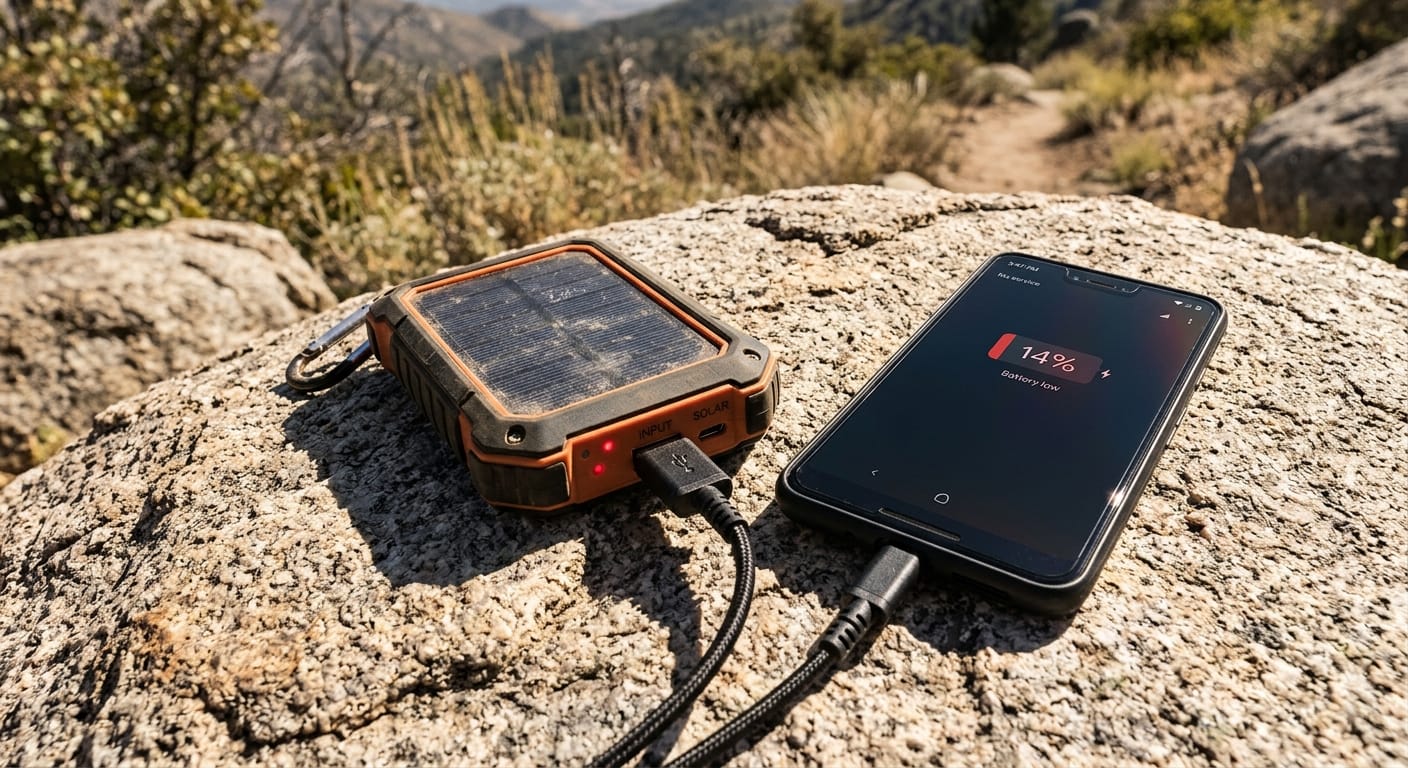
If you bought a $30 rugged solar battery pack hoping for endless, self-sustaining off-grid energy, you have likely run into an infuriating reality: that tiny green charging LED blinks all day in the blistering sun, yet your phone barely gains a 10% charge. So, do solar power banks work, or are they an outdoor marketing gimmick?
The short answer is a hard reality check: the battery works fine, but the integrated solar panel is practically useless for daily power needs. Marketing photos showing a power bank clipped to a backpack while powering cameras, phones, and GPS devices ignore elementary electrical engineering. To understand why, you have to look at the math behind solar surface area and cell capacity.
The 1-Watt Myth vs. 20,000mAh Battery Math
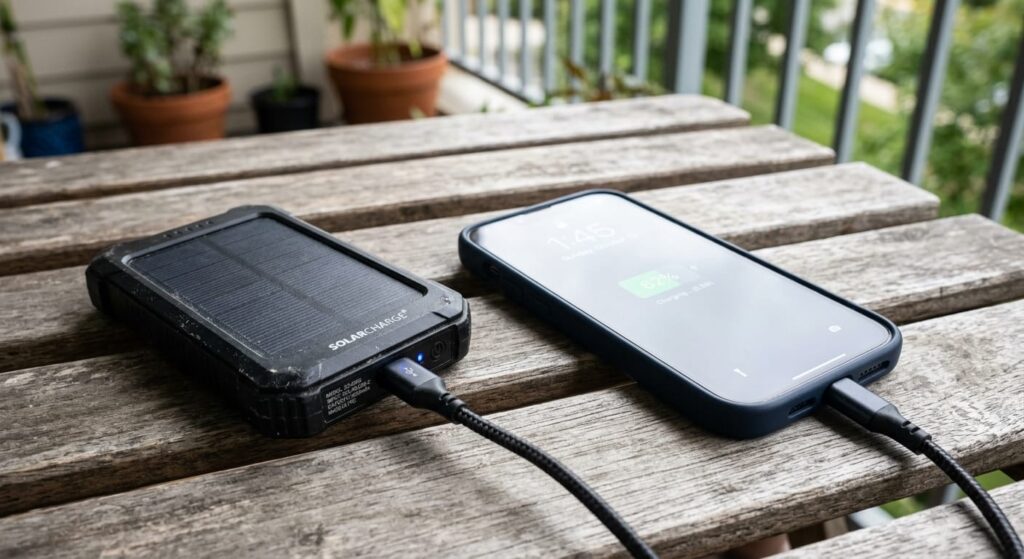
To understand how to charge solar power bank hardware effectively, look at the energy capacity inside the shell. A standard 20,000mAh battery pack contains lithium cells operating at a nominal voltage of 3.7V:
Capacity = 20 Ah × 3.7 V = 74 Watt-hours (Wh)
Now look at the tiny photovoltaic strip mounted on top of the pack. Measuring roughly 2.5 by 5 inches, that miniature silicon panel can generate—at best—around 200mA to 250mA of current at 5V under direct, perpendicular, cloudless noon sunlight. That equates to roughly 1.0W to 1.25W of peak generation.
Real-world conditions reduce that figure further. Factor in imperfect sun angles, slight atmospheric haze, and the unavoidable ~20% energy conversion loss within the charging and protection circuitry (80% charging efficiency). Your net energy intake drops to roughly 0.8W to 1.0W per hour:
Recharge Time = 74 Wh / 1.0 W ≈ 74 hours of peak sunlight
Given that most regions yield an average of 4 to 5 “peak sun hours” per day, fully recharging a depleted 20,000mAh battery using its integrated panel solely requires 60 to 75 hours of unobstructed direct sunlight—that is nearly two weeks of continuous, perfectly angled daylight. Relying on that postage-stamp panel as a primary power source is an exercise in futility.
The Thermal Degradation Trap: Why Sun Basking Kills Batteries
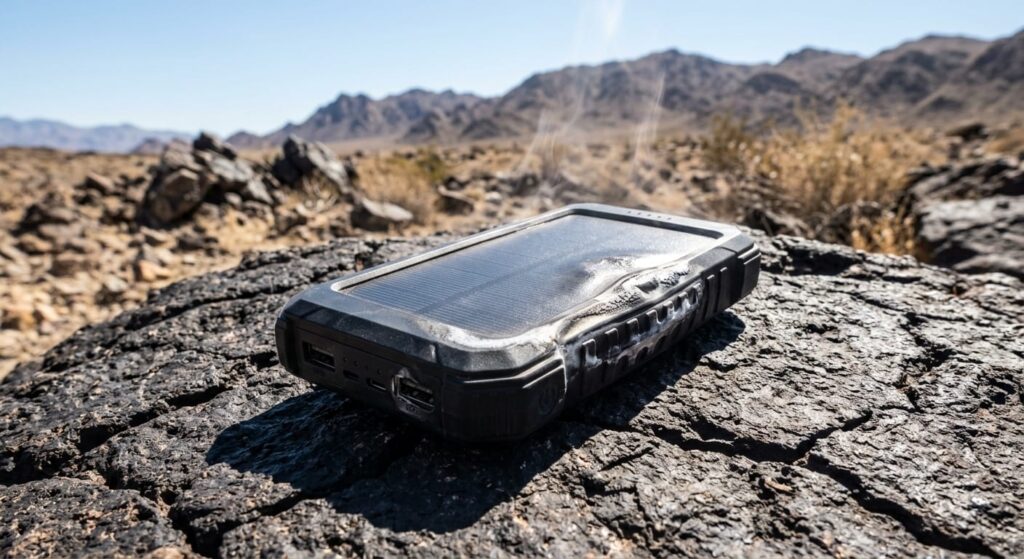
The math is only half the problem; the physical environment is worse. Solar panels require direct, unobstructed heat and UV exposure to generate electricity. Lithium-ion and lithium-polymer cells, however, degrade rapidly when exposed to high heat.
When you leave a heavy, dark rubber-and-plastic battery casing sitting on a sun-baked rock, a picnic table, or a vehicle dashboard in 90°F+ (32°C) ambient weather, internal enclosure temperatures easily exceed 130°F to 140°F (55°C–60°C).
Baking lithium chemistry under intense thermal stress triggers distinct failure modes:
- Accelerated Electrolyte Breakdown: Sustained high temperatures cause parasitic chemical reactions inside the cell, permanently reducing usable capacity.
- Cycle Life Collapse: Heat degrades the cathode materials, cutting a battery’s lifespan from 500+ cycles down to a fraction of that.
- Pouch Swelling (“Spicy Pillows”): Excessive heat causes off-gassing within pouch-style lithium cells, resulting in casing distortion, seal failure, and potential thermal runaway.
Subjecting an all-in-one solar battery pack to the exact environment it needs to charge slowly destroys the very battery inside it.
How to Actually Use a Solar Power Bank Correctly

Understanding how to use solar power bank units in the field comes down to managing expectations and establishing strict operating boundaries.
First, treat the integrated solar panel strictly as an emergency trickle-charger. If you are stranded off-grid with an exhausted battery and need to make a critical 911 SOS text or transmit an emergency GPS beacon, setting the pack in the sun for 3 to 4 hours can trickle in roughly 3% to 5% of battery capacity. That small burst is enough to boot an efficient smartphone, acquire a satellite lock, and broadcast your coordinates. That is its sole legitimate engineering purpose.
Second, adopt the golden operational rule: Always pre-charge the battery to 100% from an AC wall outlet or high-output vehicle charger before heading off-grid. The battery pack is your primary energy reserve; the solar panel is merely an emergency failsafe.
The Real Off-Grid Camping Charging Setup
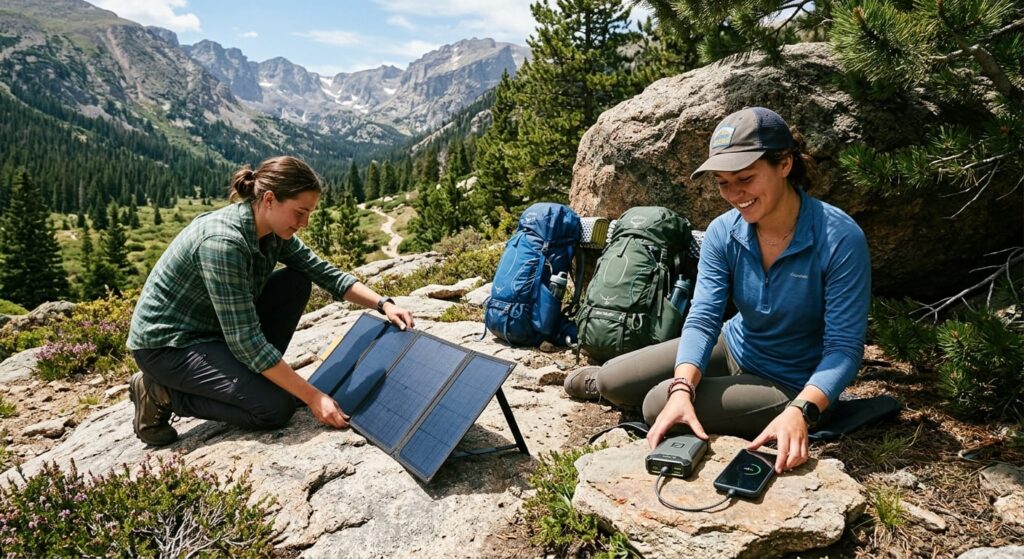
If you need genuine, continuous off-grid electricity for extended backcountry trips, the solution is simple: decouple the solar collector from the battery pack. By separating the components, you can orient large-surface-area panels directly toward the sun while keeping your sensitive lithium storage bank tucked away in cool, ventilated shade.
A robust field setup consists of three practical components:
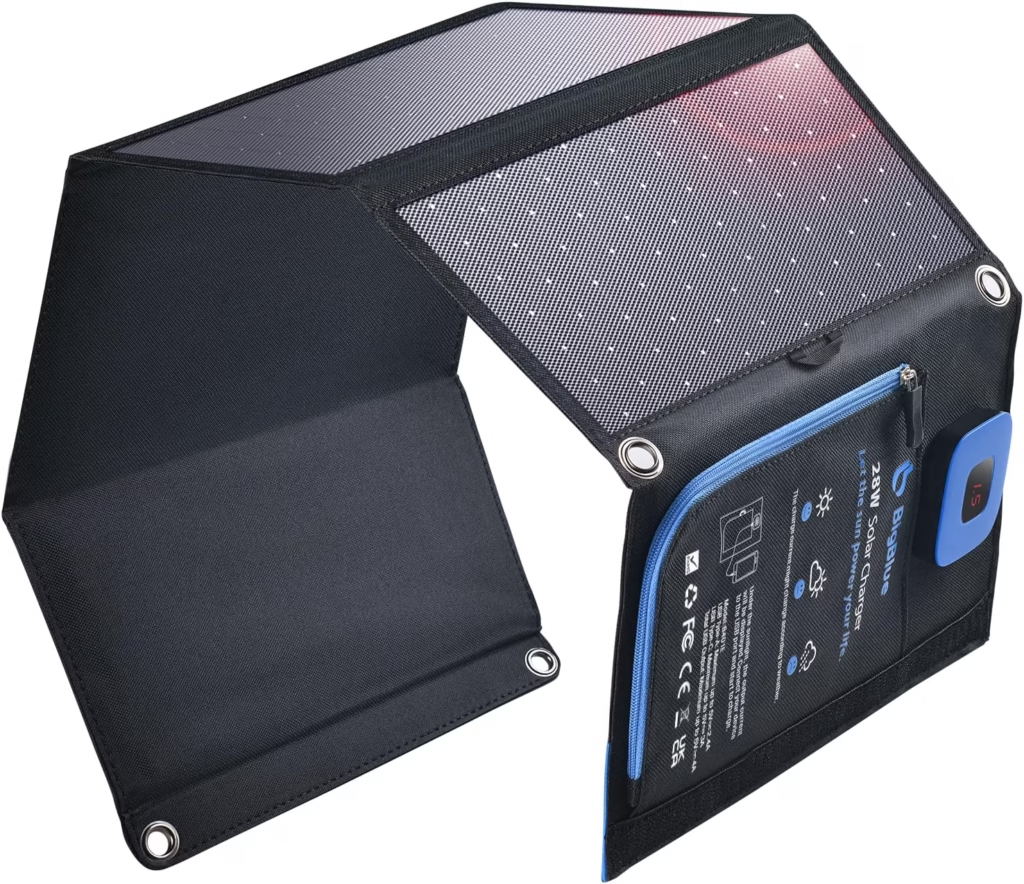
- The Separated Solar Array — Foldable 24W–28W USB Solar Charger (Big Blue 28W)
A multi-panel folding array provides the physical surface area needed to harvest meaningful energy, delivering 15W to 20W of real-world power under direct sunlight. It folds flat into a backpack, and its multi-foot output cable allows you to prop the solar array in full sun while resting your power bank beneath a tent vestibule or shade tree. For a deeper breakdown of matching panel wattage to your gear, explore our field-tested recommendations on the best portable solar chargers and gear.
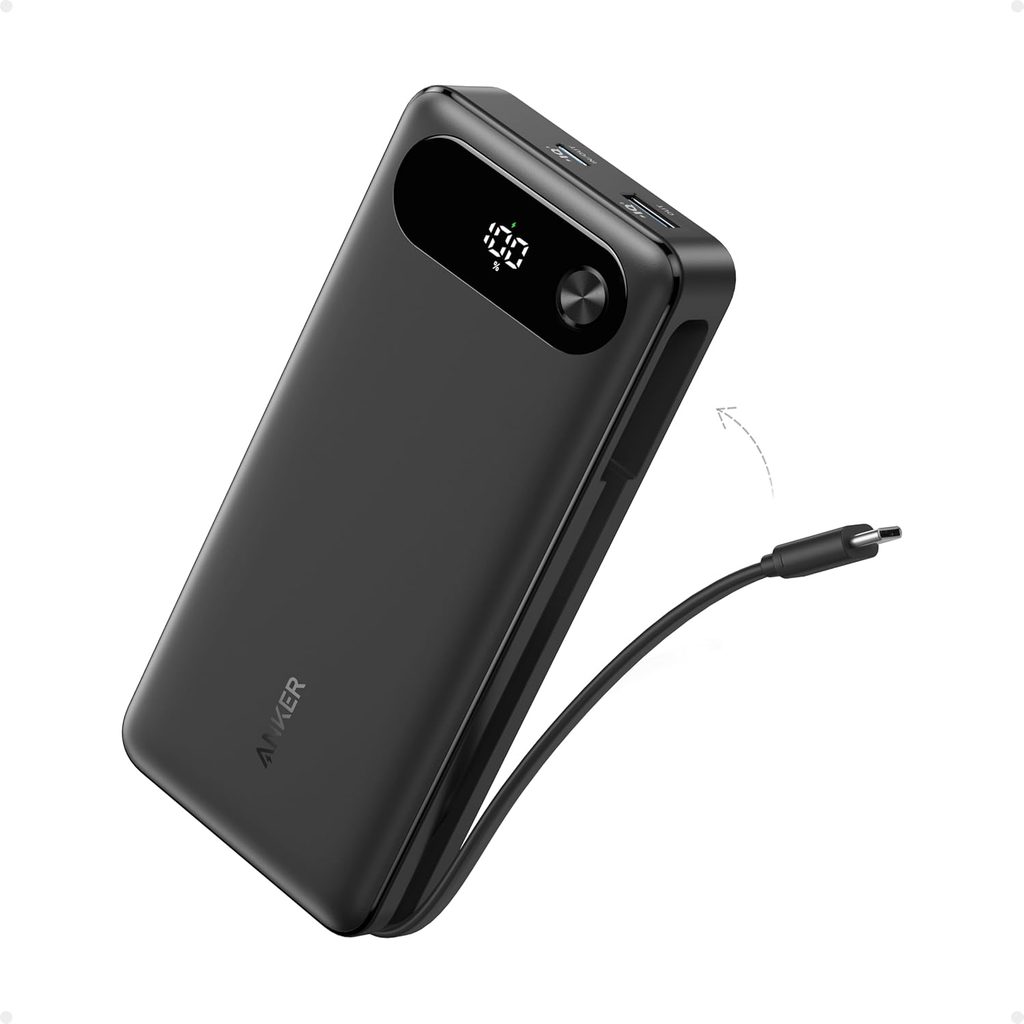
- High-Efficiency Heavy-Duty Camping Power Bank (Anker 20,000 mAh 65W PD)
Choosing the best power bank for camping comes down to two-way USB-C Power Delivery (PD) capable of accepting high input wattages, a durable enclosure, and sufficient capacity (74Wh–88Wh) to keep gear powered for days.
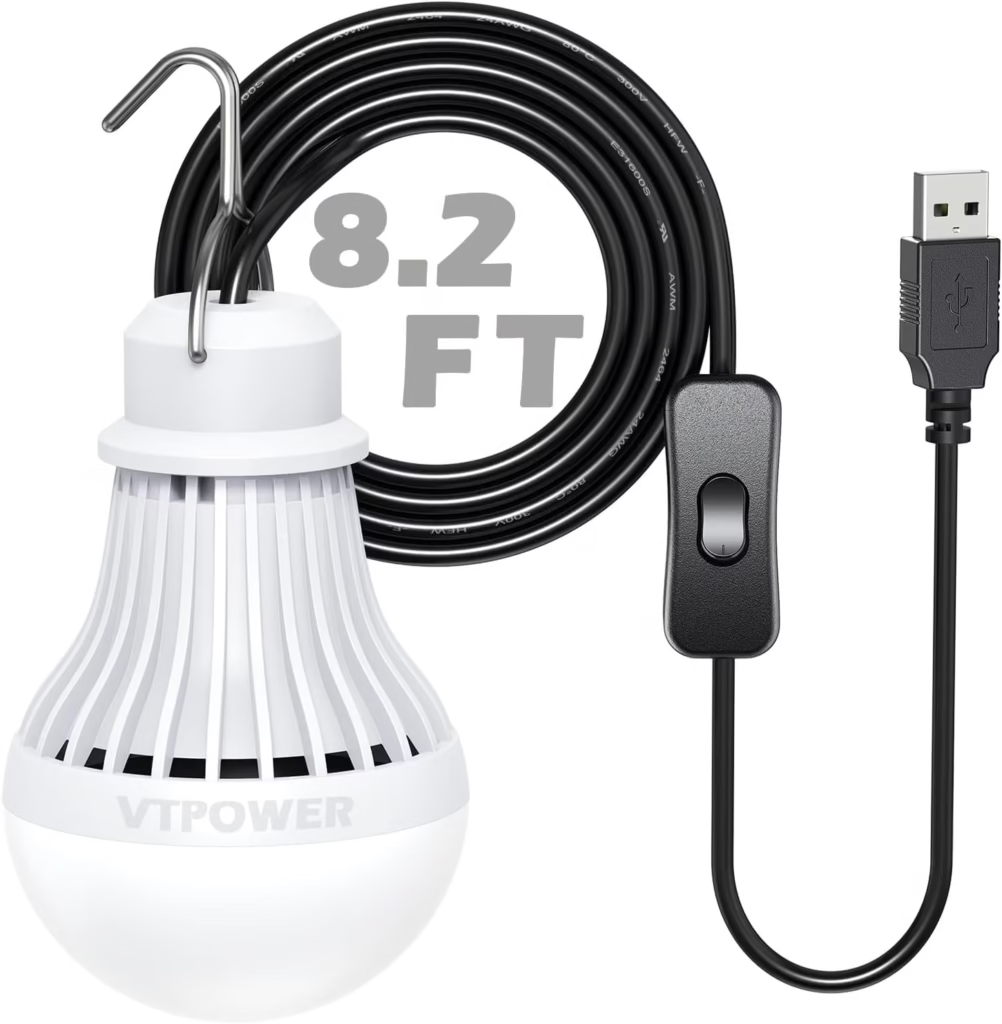
- Low-Draw Hanging USB Camping Light Bulb with Hook
[USB LED Camping Lantern with Switch]
Rather than burning heavy wattage on camp lighting, a dedicated camping usb light pulls a modest 2W to 5W while delivering 200 to 300 lumens of diffuse illumination. It plugs straight into your power bank’s USB-A port, turning your battery into an ultra-efficient 20+ hour camp lantern without wasting precious stored watt-hours. Integrating efficient, minimal-draw equipment alongside your proven emergency blackout accessories guarantees your baseline power never runs dry.
| Charging Source | Real-World Wattage | Time to Charge 20,000mAh (74Wh) | Practical Field Feasibility |
|---|---|---|---|
| Built-in ~1W Panel (Budget Power Bank) | ~0.8W – 1.0W | 60 – 75+ hours (~12–15 peak sun days) | Impractical: Emergency trickle/SOS survival only |
| 28W Foldable Solar Panel (USB) | ~15W – 20W | 4 – 5.5 hours (under 1 afternoon of sun) | High: Reliable, daily off-grid replenishment |
| 65W AC Wall Outlet (USB-C PD) | ~45W – 65W | 1.5 – 2.2 hours | Essential: Standard basecamp prep before departure |

Reliable off-grid electricity is never a matter of marketing claims or ruggedized rubber bumpers—it is dictated by the hard physics of surface area versus cell volume. Ditch the expectation that a pocket-sized solar gadget can sustain modern electronics, keep your battery cool in the shade, and pair an adequate solar array with your storage bank to keep your gear powered anywhere.
Leave a Reply